

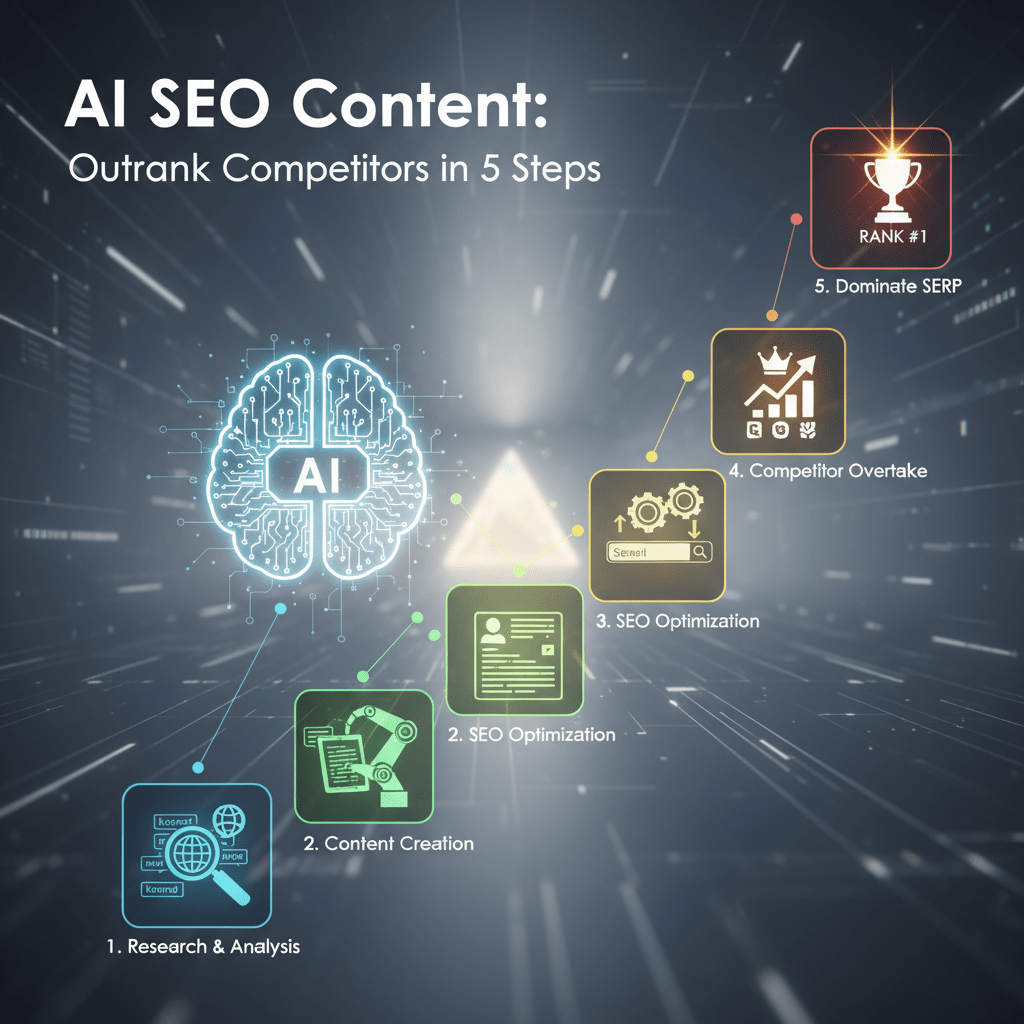
AI SEO Content: Outrank Competitors in 5 Steps
Tired of your content disappearing into the digital abyss? In today’s hyper-competitive online landscape, creating content that simply “exists” isn’t enough. You need content that dominates search engine results pages (SERPs), drives organic traffic, and converts visitors into loyal customers. That’s where AI-powered SEO content comes in. This isn’t about replacing human creativity, but about augmenting it with the speed, precision, and data-driven insights that only AI can provide. This guide will walk you through a five-step process to leverage AI and outrank your competitors.
Step 1: Supercharge Your Keyword Research with AI
Keyword research is the foundation of any successful SEO strategy. Traditional methods can be time-consuming and prone to bias. AI revolutionizes this process by analyzing vast datasets of search queries, competitor rankings, and user behavior to uncover hidden keyword opportunities and predict future trends. Forget guessing – let AI show you exactly what your target audience is searching for.
Leveraging AI-Powered Keyword Research Tools
Several AI-powered tools can help you identify high-potential keywords. These tools go beyond simple keyword volume and competition scores. They analyze the search intent behind keywords, identify related terms, and even suggest long-tail variations you might have missed. By understanding the user’s true needs, you can create content that provides genuine value and satisfies their search queries.
- Identify hidden keyword opportunities: AI can analyze competitor websites, industry trends, and social media conversations to uncover keywords that are relevant to your niche but haven’t been widely targeted.
- Understand search intent: AI algorithms can analyze the context and phrasing of search queries to determine the user’s intent (informational, navigational, transactional). This allows you to tailor your content to match the user’s needs.
- Generate long-tail keyword variations: AI can automatically generate long-tail keyword variations that are more specific and less competitive, increasing your chances of ranking higher.
For example, instead of just targeting “SEO,” AI might suggest long-tail keywords like “best SEO practices for e-commerce” or “affordable SEO services for small businesses.” These longer, more specific queries often have lower competition and higher conversion rates.
Analyzing Competitor Keyword Strategies with AI
Understanding your competitors’ keyword strategies is crucial for gaining a competitive edge. AI-powered tools can analyze your competitors’ websites, backlinks, and content to identify the keywords they are targeting and the strategies they are using to rank higher. This information can help you refine your own keyword strategy and identify opportunities to outrank them.
- Identify top-performing keywords: AI can reveal the keywords that are driving the most traffic to your competitors’ websites.
- Analyze backlink profiles: AI can analyze your competitors’ backlink profiles to identify high-quality backlinks that you can target.
- Identify content gaps: AI can identify topics that your competitors are not covering, creating opportunities for you to create unique and valuable content.
Consider using tools like Semrush, Ahrefs, or Surfer SEO. These platforms offer AI-driven features for keyword research, competitor analysis, and content optimization. By using these tools, you can gain a significant advantage over competitors who are still relying on traditional methods. You might also find valuable insights related to AI-Powered Content Optimization Tips that can enhance your overall SEO approach.
Step 2: Craft Compelling Content with AI Assistance
Once you have identified your target keywords, it’s time to create content that is both engaging and optimized for search engines. AI can assist you in this process by generating content ideas, outlining articles, and even writing entire drafts. However, it’s important to remember that AI should be used as a tool to enhance your creativity, not replace it. The best approach is to combine AI-generated content with your own expertise and insights to create content that is truly unique and valuable.
Generating Content Ideas with AI
Struggling to come up with fresh content ideas? AI can help you brainstorm topics that are relevant to your target audience and aligned with your keyword strategy. By analyzing industry trends, social media conversations, and competitor content, AI can identify emerging topics and unmet needs. This can help you create content that is timely, relevant, and likely to attract attention.
For instance, if you’re in the marketing niche, AI could suggest topics like “The Future of AI in Social Media Marketing” or “How to Use AI to Personalize Email Campaigns.” These topics are both timely and relevant, and they address the growing interest in AI within the marketing industry.
Outlining Articles with AI
A well-structured outline is essential for creating clear and engaging content. AI can help you create outlines that are logically organized and optimized for readability. By analyzing top-ranking articles for your target keywords, AI can identify the key topics and subtopics that you should cover in your own content. This ensures that your content is comprehensive, informative, and meets the needs of your audience.
Consider using tools like Jasper.ai, Copy.ai, or Rytr. These platforms offer AI-powered outlining tools that can help you create structured and compelling content. Remember to always review and refine the AI-generated outlines to ensure that they are aligned with your own vision and expertise.
Enhancing Content with AI-Powered Writing Tools
AI-powered writing tools can assist you with various aspects of the writing process, such as grammar checking, style editing, and plagiarism detection. These tools can help you improve the quality and clarity of your writing, ensuring that your content is error-free and professional. They can also help you optimize your content for readability, making it easier for your audience to understand and engage with your message.
While AI can provide a strong first draft, it’s crucial to infuse your brand’s voice and unique perspective into the content. Think of AI as a powerful assistant that can help you get started, but your expertise is what will truly make the content stand out. Content creation can also be streamlined through AI Content Generation Secrets, helping you produce more quality material in less time.
Step 3: Optimize On-Page SEO with AI Precision
On-page SEO involves optimizing various elements of your website to improve its ranking in search engine results pages. This includes optimizing your title tags, meta descriptions, headings, and content. AI can help you automate and optimize these tasks, ensuring that your website is fully optimized for search engines. Effective on-page optimization ensures your content is easily understood by both users and search engines, leading to improved rankings and increased organic traffic.
Optimizing Title Tags and Meta Descriptions with AI
Your title tag and meta description are the first things that users see in search results. These elements play a crucial role in attracting clicks and driving traffic to your website. AI can help you optimize your title tags and meta descriptions by generating compelling and keyword-rich copy that accurately reflects the content of your page. AI can also analyze the performance of your title tags and meta descriptions to identify areas for improvement.
For example, AI can analyze the click-through rate (CTR) of your title tags and meta descriptions and suggest changes that are likely to increase CTR. This can significantly improve your website’s visibility in search results and drive more traffic to your pages. Remember to keep your title tags concise (under 60 characters) and your meta descriptions informative (under 160 characters).
Optimizing Headings and Content Structure with AI
Your headings and content structure play a crucial role in readability and SEO. Well-structured content is easier for users to understand and navigate, and it also helps search engines understand the topic of your page. AI can help you optimize your headings and content structure by suggesting appropriate heading tags (H1, H2, H3), identifying relevant subtopics, and ensuring that your content is logically organized.
Use tools that analyze top-ranking content for your target keywords and identify the heading structures that are most effective. You can then use this information to create a similar structure for your own content, ensuring that it is both user-friendly and search engine optimized. Make sure your headings include relevant keywords and accurately reflect the content of each section.
Internal Linking and User Experience
Strategic internal linking is crucial for both SEO and user experience. Internal links help search engines understand the relationship between different pages on your website and improve the overall crawlability of your site. They also help users navigate your website and discover relevant content. AI can help you identify internal linking opportunities by analyzing the content of your pages and suggesting relevant links. Think about how SEO Content Optimization: Real Examples & AI Strategies can play a part in developing your linking strategies.
For example, if you have a page about “AI in Marketing,” AI can suggest linking to other pages on your website that discuss specific AI marketing tools or strategies. This can help users discover more of your content and improve your website’s overall SEO performance. Make sure your internal links are relevant, natural, and provide value to the user.

Step 4: Build High-Quality Backlinks with AI-Driven Insights
Backlinks are still a crucial ranking factor in Google’s algorithm. Earning high-quality backlinks from reputable websites can significantly improve your website’s authority and visibility in search results. AI can assist you in your backlink building efforts by identifying potential link opportunities, analyzing competitor backlink profiles, and automating outreach efforts.
Identifying Link Opportunities with AI
AI can analyze your industry, competitors, and target audience to identify websites that are likely to link to your content. This includes identifying websites that have linked to similar content in the past, websites that are relevant to your niche, and websites that are actively seeking content. By identifying these opportunities, you can focus your outreach efforts on websites that are most likely to provide a valuable backlink.
Tools like Ahrefs and Semrush have features that can help find sites in your niche that are likely to link to you. By entering relevant keywords and competitor domains, you can get a list of potential websites to target.
Analyzing Competitor Backlink Profiles with AI
Analyzing your competitors’ backlink profiles can provide valuable insights into their link building strategies. AI can help you identify the websites that are linking to your competitors, the types of content that are attracting backlinks, and the anchor text that they are using. This information can help you refine your own backlink building strategy and identify opportunities to earn backlinks from the same websites.
For example, if you notice that your competitors are earning backlinks from industry directories, you can consider submitting your own website to those directories. Similarly, if you notice that they are earning backlinks from guest posts, you can consider writing guest posts for similar websites. Analyzing how AI Content Optimization drives relevant backlinks can assist with your link-building efforts.
Automating Outreach Efforts with AI
Outreach is a time-consuming but essential part of backlink building. AI can help you automate various aspects of the outreach process, such as finding contact information, personalizing email templates, and tracking your results. By automating these tasks, you can save time and focus on building relationships with potential link partners.
Consider using tools like Hunter.io to find email addresses and Mailshake to automate your outreach emails. Remember to always personalize your emails and provide value to the recipient. Generic, automated emails are likely to be ignored.
Step 5: Track, Analyze, and Refine with AI-Powered Analytics
SEO is an ongoing process, and it’s essential to track your results, analyze your data, and refine your strategy based on your findings. AI can help you automate and optimize this process by providing insights into your website’s performance, identifying areas for improvement, and predicting future trends. Continuous monitoring and adjustment based on AI-driven insights are crucial for long-term SEO success. Keep an eye on Content Marketing Automation: AI SEO Secrets to learn how you can make adjustments for maximum returns.
Monitoring Website Performance with AI
AI can monitor your website’s performance across various metrics, such as organic traffic, keyword rankings, bounce rate, and conversion rate. By tracking these metrics, you can identify trends and patterns that can help you understand what is working and what is not.
Use tools like Google Analytics and Google Search Console to track your website’s performance. These tools provide valuable data on your website’s traffic, keyword rankings, and other important metrics. You can then use AI-powered tools to analyze this data and identify areas for improvement.
Identifying Areas for Improvement with AI
AI can analyze your website’s data to identify areas where you can improve your SEO performance. This includes identifying pages that are underperforming, keywords that are declining in rankings, and technical SEO issues that are affecting your website’s crawlability. By identifying these issues, you can take action to address them and improve your website’s overall SEO performance.
For example, AI can identify pages that have a high bounce rate, indicating that users are not finding the content valuable. You can then review these pages and make changes to improve their content, design, or user experience.
Predicting Future Trends with AI
AI can analyze historical data and industry trends to predict future SEO trends. This includes predicting changes in search engine algorithms, emerging keyword opportunities, and shifts in user behavior. By understanding these trends, you can proactively adapt your SEO strategy and stay ahead of the competition.
For example, AI can predict that mobile search will continue to grow, prompting you to focus on optimizing your website for mobile devices. Similarly, AI can predict that voice search will become more popular, prompting you to optimize your content for voice queries.
Conclusion
By following these five steps, you can leverage the power of AI to create SEO content that outranks your competitors and drives organic traffic to your website. Remember that AI is a tool to augment your creativity and expertise, not replace it. By combining AI-driven insights with your own knowledge and skills, you can create content that is both engaging and optimized for search engines. The future of SEO is undoubtedly intertwined with AI, and embracing this technology will be crucial for success in the years to come. Start experimenting with AI tools today and see how they can transform your SEO strategy.