


E-commerce businesses thrive on visibility. In today’s crowded online marketplace, consistent, high-quality content is no longer a luxury; it’s a necessity for driving organic traffic, building brand authority, and ultimately, boosting sales. But managing content creation across numerous product categories, seasonal promotions, and ever-evolving SEO best practices can quickly become overwhelming.
Content automation offers a solution, promising to streamline the process and unlock significant SEO potential. This guide dives deep into how content automation can revolutionize your e-commerce SEO strategy, providing actionable steps and insights to help you scale your content efforts effectively.
Is Your E-commerce Content Strategy Drowning in Manual Tasks?
The Time Sink of Traditional Content Creation: Research, Writing, and Optimization
Manually creating content for an e-commerce store is a significant time investment. Consider the steps involved: keyword research to identify relevant search terms, competitor analysis to understand the existing landscape, writing compelling product descriptions and blog posts, optimizing content for search engines, sourcing or creating relevant images and videos, and finally, publishing and promoting the content. Each of these steps requires specialized skills and can quickly consume valuable hours, especially when dealing with a large product catalog or diverse content needs. For instance, writing just 5 unique product descriptions per day can easily take up half a day for a copywriter, which is before you start creating other types of content.
Identifying Content Bottlenecks in E-commerce SEO
Identifying specific bottlenecks is crucial before implementing any automation strategy. Are your product descriptions generic and lacking in detail? Is your blog content outdated or inconsistent? Are you struggling to keep up with keyword research and competitor analysis? Are your category pages poorly optimized for search? Documenting these pain points will highlight the areas where content automation can provide the most significant impact. For example, if keyword research is a bottleneck, tools within your content automation platform can identify long-tail keywords and related topics you may be missing. Another bottleneck could be consistent publishing. Perhaps you have great content ideas, but lack the manpower to create them regularly. AI-powered automation can help you overcome this hurdle.
Quantifying the ROI of Automated Content Solutions
To justify the investment in content automation, it’s essential to quantify the potential ROI. Start by calculating the current cost of manual content creation, including salaries, freelancer fees, and the time spent by internal teams. Then, estimate the potential increase in organic traffic, leads, and sales that could result from improved content quality and consistency. Consider factors such as increased website ranking, improved click-through rates, and higher conversion rates. For example, if your manual content creation process costs $5,000 per month and generates 1,000 organic visitors, a content automation solution that doubles your organic traffic could potentially generate an additional $5,000 in revenue (assuming a consistent conversion rate and average order value). It’s also important to factor in the time savings and the ability to focus resources on other critical business areas.
The E-commerce SEO Opportunity: Why Consistent, High-Quality Content Matters
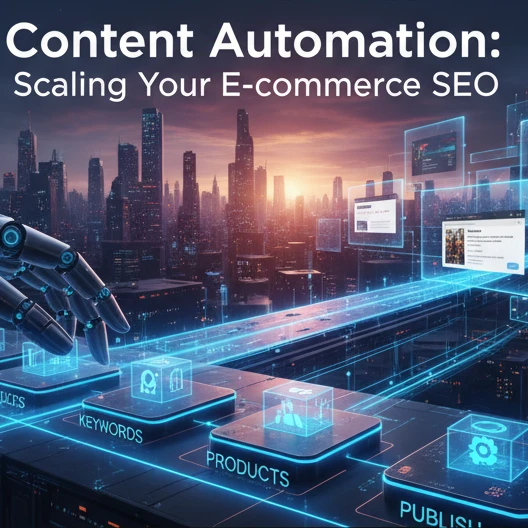
Attracting Targeted Traffic: How Informational Content Drives Sales
Informational content, such as blog posts, guides, and tutorials, plays a crucial role in attracting targeted traffic to your e-commerce store. By answering customer questions, addressing their pain points, and providing valuable insights, you can establish your brand as a trusted authority and attract potential buyers who are actively searching for solutions. For instance, a blog post titled “The Ultimate Guide to Choosing the Right Hiking Boots” can attract users searching for hiking boot advice, ultimately leading them to your e-commerce store where they can purchase the recommended boots. This content pre-qualifies visitors, increasing the likelihood of a purchase.
Building Authority and Trust: Establishing Your Brand as a Resource
Consistent publishing of high-quality content helps build authority and trust with your target audience. When you consistently provide valuable information and demonstrate expertise in your niche, customers are more likely to view your brand as a reliable source and trust your product recommendations. This increased trust translates into higher conversion rates and repeat business. For example, a furniture retailer consistently publishing articles on interior design trends, furniture care tips, and space-saving solutions will establish itself as an authority in the home décor space. Furthermore, consistently publishing valuable information can improve your website’s E-E-A-T (Experience, Expertise, Authoritativeness, and Trustworthiness) which is a ranking factor Google considers.
Long-Tail Keywords and Product Discovery: Reaching Niche Audiences
Long-tail keywords, which are longer and more specific search queries, represent a significant opportunity for e-commerce SEO. These keywords often have lower search volume but higher conversion rates, as they target users with very specific needs. By creating content that targets long-tail keywords, you can reach niche audiences and drive highly qualified traffic to your product pages. For example, instead of targeting the broad keyword “coffee maker,” target the long-tail keyword “best coffee maker for small apartments with a built-in grinder”. Content automation can help you identify and target these valuable long-tail keywords at scale, by analyzing search data and automatically generating relevant content.
What is Content Automation for E-commerce, Really?
Defining Content Automation: Beyond Simple Article Spinning
Content automation is more than just article spinning or rewriting existing content. It involves using technology to streamline and automate various stages of the content creation process, from keyword research and topic ideation to writing, optimization, and publishing. True content automation uses structured data, templates, and pre-defined rules to generate unique and relevant content at scale, while maintaining quality and consistency. This allows e-commerce businesses to create large volumes of SEO-optimized content without sacrificing quality or relying solely on manual effort. Content automation can include tasks like automatic product description generation based on attributes, automatic generation of FAQ pages based on customer queries, or automatic creation of comparison pages highlighting the differences between similar products.
Key Features to Look for in a Content Automation Platform
When evaluating content automation platforms, look for features such as: keyword research and topic clustering capabilities, customizable content templates and brand guidelines, integration with e-commerce platforms and SEO tools, AI-powered writing and optimization tools, automated publishing and scheduling, and performance tracking and reporting. The platform should also offer flexibility and scalability to adapt to your evolving content needs. A good platform should also allow you to input data about your brand voice and tone to ensure that automated content aligns with your brand identity. Furthermore, consider the platform’s ability to handle different content types, such as product descriptions, blog posts, and category page copy.
Distinguishing Content Automation from AI-powered Article Generation
While AI-powered article generation is a component of content automation, it’s not the whole picture. AI-powered article generation tools can assist with writing and brainstorming, but they often require significant human oversight to ensure accuracy, relevance, and brand consistency. Content automation, on the other hand, encompasses a broader range of tools and processes that automate the entire content lifecycle, from initial research to final publishing. A true content automation solution leverages AI, but also incorporates templates, rules, and workflows to ensure content quality and alignment with business goals. Think of AI-powered article generation as a single tool in a larger content automation toolbox. AI content automation allows you to focus on strategy, not just execution.
Implementing a Content Automation Workflow: A Step-by-Step Guide
Step 1: Keyword Research and Topic Clustering for E-commerce
The foundation of any successful content automation strategy is thorough keyword research. Identify the keywords and phrases that your target audience is using to search for your products and services. Use keyword research tools to uncover high-volume and long-tail keywords, and then group these keywords into topic clusters based on their relevance. For example, a topic cluster for “running shoes” might include keywords such as “best running shoes for beginners,” “running shoes for flat feet,” and “trail running shoes.” This step is critical for ensuring that your automated content targets the right audience and addresses their specific needs. Tools like Google Keyword Planner, Ahrefs, and SEMrush are valuable resources for keyword research and topic discovery.
Step 2: Setting Up Content Templates and Brand Guidelines
Once you have your topic clusters, create content templates that can be used to generate consistent and high-quality content at scale. These templates should include sections for headlines, introductions, body paragraphs, calls to action, and relevant images or videos. Define clear brand guidelines that specify the tone, style, and voice of your content. This will ensure that all automated content aligns with your brand identity and messaging. A product description template, for example, should include fields for key product features, benefits, technical specifications, and warranty information. Consistent use of templates streamlines the content creation process and ensures a unified brand experience. This consistency is something algorithms love.
Step 3: Automating Content Creation and Optimization with SEO45 AI
Now comes the automation stage, where SEO45 AI really shines. Feed your keywords, topic clusters, content templates, and brand guidelines into the SEO45 AI platform. The platform will then automatically generate SEO-optimized content based on your specifications. SEO45 AI leverages advanced natural language processing (NLP) to write compelling and informative content that resonates with your target audience. The platform also incorporates SEO best practices, such as keyword optimization, meta description generation, and internal linking, to ensure that your content ranks high in search results. Remember to regularly review and refine the automated content to ensure accuracy and relevance.
Step 4: Publishing and Tracking Content Performance
Once the content is created and optimized, schedule it for publishing on your e-commerce website, blog, and social media channels. Track the performance of your content using analytics tools to measure metrics such as organic traffic, keyword rankings, bounce rate, conversion rate, and social engagement. Use these insights to identify areas for improvement and refine your content automation strategy. A/B test different headlines, calls to action, and content formats to optimize your results. Continuously monitor your content’s performance and make adjustments as needed to maximize its impact. This iterative process of creation, measurement, and optimization is key to long-term success with content automation.
Optimizing Product Descriptions at Scale: A Content Automation Use Case
Crafting Compelling Product Descriptions with AI Assistance
E-commerce businesses with hundreds or thousands of products often struggle to create unique, engaging, and SEO-friendly product descriptions for each item. Content automation, particularly AI-powered writing tools, can significantly streamline this process. Instead of relying solely on manual writing, businesses can input product specifications, features, and target keywords into an AI content generator to produce initial drafts. These drafts then serve as a foundation for human editors to refine, inject brand voice, and ensure accuracy.
A crucial decision point is choosing the right AI tool. Consider factors like the quality of the output (grammar, coherence, relevance), the ability to customize the tone and style, the integration with your existing e-commerce platform, and the pricing model. Be wary of tools that promise unrealistic results or generate generic, repetitive descriptions. Also, prioritize solutions that offer plagiarism checking to avoid potential SEO penalties.
Example: An online retailer selling electronics uses AI to generate product descriptions for its range of headphones. The AI tool ingests data such as the headphone type (over-ear, in-ear), connectivity (Bluetooth, wired), battery life, noise cancellation features, and target audience (commuters, gamers). It then generates several description variations. A human editor selects the best option and adds a unique selling proposition: “Experience unparalleled sound clarity on your daily commute with these noise-canceling headphones.”
Incorporating LSI Keywords and Semantic Search Principles
Modern SEO goes beyond targeting exact-match keywords. Latent Semantic Indexing (LSI) keywords and semantic search principles are crucial for improving product description relevance. Content automation tools can assist in identifying LSI keywords related to your products and seamlessly incorporating them into the descriptions. These tools analyze top-ranking content for similar products and suggest relevant terms and phrases that users are likely to search for.
For example, if your primary keyword is “organic cotton baby clothes,” LSI keywords might include “hypoallergenic baby clothes,” “sustainable baby clothing,” “gentle baby fabric,” or “GOTS-certified cotton.” Use the AI tool to automatically integrate these related terms naturally within the product descriptions. Focus on creating contextually relevant content that answers user questions and provides valuable information about the product.
A key consideration is the natural flow of the content. Overstuffing descriptions with keywords, even LSI keywords, can negatively impact readability and user experience. Strive for a balance between SEO optimization and engaging, informative content. Regularly review and update your product descriptions to reflect changes in search trends and customer preferences. Competitive analysis using AI can also reveal keywords used by top-performing competitors.
Automated A/B Testing of Product Description Variations
Even the best-written product descriptions can be further optimized through A/B testing. Content automation can facilitate this process by automatically creating multiple variations of your product descriptions, each with different headlines, calls to action, or keyword placements. These variations can then be tested against each other to determine which performs best in terms of click-through rates, conversion rates, and other key metrics.
Many e-commerce platforms offer built-in A/B testing features or integrate with third-party testing tools. Use these tools to automatically rotate different product description variations and track their performance. Focus on testing specific elements, such as the headline, the opening paragraph, or the call to action, to isolate the impact of each change. For example, you might test two variations of a headline: “Buy Now and Get Free Shipping” versus “Limited Time Offer: Free Shipping on Orders Over $50.”
Example: An online shoe store runs A/B tests on its product descriptions. Version A highlights the shoe’s comfort and cushioning features, while Version B emphasizes its durability and weather resistance. After a two-week testing period, Version A shows a 15% higher conversion rate, indicating that customers are more interested in comfort than durability. The store then implements Version A as the standard product description for that shoe model.
Creating Informational Content Around Your Products: Blog Posts, Guides, and More
Identifying Relevant Topics for Your E-commerce Niche
Beyond product descriptions, informational content like blog posts, guides, and tutorials can significantly boost your e-commerce site’s SEO. Content automation can help identify relevant topics that resonate with your target audience and align with your product offerings. Start by conducting keyword research to uncover common questions, pain points, and interests related to your niche. Tools like Google Keyword Planner, SEMrush, or Ahrefs can provide valuable insights into search volume and keyword difficulty.
Consider using AI-powered topic generation tools that analyze your existing content, customer reviews, and competitor websites to suggest new and relevant topic ideas. These tools can identify gaps in your content strategy and help you create content that addresses unmet user needs. For example, if you sell coffee beans, potential blog topics could include “The Ultimate Guide to Brewing French Press Coffee,” “The Health Benefits of Organic Coffee,” or “Coffee Bean Origin Guide: Exploring Ethiopian Yirgacheffe.” AI-powered content can then be leveraged to create these guides.
Remember to focus on creating content that provides genuine value to your audience. Don’t simply create content for the sake of SEO; instead, aim to educate, inform, and entertain your readers. By establishing yourself as a trusted source of information, you can attract more organic traffic, build brand loyalty, and ultimately drive more sales.
Automating the Research and Outline Creation Process
Once you’ve identified relevant topics, content automation can streamline the research and outline creation process. AI-powered research tools can automatically gather information from various sources, including competitor websites, industry reports, and academic papers. These tools can summarize key findings, identify relevant statistics, and extract quotes to support your arguments.
Based on the research, AI-powered outline generators can create structured outlines for your blog posts and guides. These outlines typically include an introduction, several main sections, and a conclusion. The AI tool can also suggest subheadings and keywords to incorporate into each section. For example, for a blog post on “The Best Running Shoes for Beginners,” the AI-generated outline might include sections on “Understanding Different Shoe Types,” “Factors to Consider When Choosing Running Shoes,” and “Top Running Shoe Recommendations for Beginners.” You can then edit and refine the outline to align with your specific goals and brand voice. Also, be sure that content is rotated with a diverse set of topics and angles per content pillar.
It’s vital to confirm sources used by automated tools. Ensure your information is accurate, up-to-date, and attributed correctly to maintain credibility. Check for bias in sources and cross-reference findings with other reliable sources.
Generating Engaging and Shareable Content with AI
With a well-researched outline in place, AI content generation tools can assist in creating engaging and shareable content. These tools can generate entire paragraphs or even full articles based on your specifications. However, it’s important to remember that AI-generated content is not a replacement for human writing. It’s best used as a starting point that can be refined and improved by human editors.
Focus on using the AI tool to generate the initial draft, then carefully review and edit the content to ensure accuracy, clarity, and originality. Add your own insights, examples, and personal anecdotes to make the content more engaging and relatable. Pay attention to the tone and style of the writing to ensure it aligns with your brand voice. Also, incorporate visuals such as images, videos, and infographics to make the content more appealing and shareable. For instance, a tutorial on using a specific software could include screenshots or a video demonstration.
Example: A company selling pet supplies uses AI to draft blog posts about pet care. The AI generates an article about “How to Train Your Puppy to Potty Outside.” A human editor then adds personal anecdotes about their own experiences with puppy training, provides specific tips based on different breeds, and incorporates high-quality images of puppies being trained. The final product is a well-written, informative, and engaging blog post that resonates with pet owners.
How Content Automation Can Improve Your E-commerce Site’s Internal Linking Structure
Identifying Internal Linking Opportunities Automatically
Internal linking is a crucial aspect of SEO that helps search engines understand the structure and relevance of your website. Content automation can significantly streamline the process of identifying internal linking opportunities by automatically scanning your website and suggesting relevant links between different pages.
AI-powered tools can analyze the content of each page and identify keywords, phrases, and topics that are related to other pages on your site. They can then suggest relevant internal links that would improve the user experience and boost your SEO. For example, if you have a blog post about “The Benefits of Vitamin C for Skin,” the tool might suggest linking to product pages for vitamin C serums or moisturizers.
Prioritize links that provide genuine value to the user and enhance their understanding of the topic. Avoid creating links simply for the sake of SEO; instead, focus on creating a seamless and intuitive browsing experience. The key is making internal links feel natural within the flow of content.
Building a Semantic Silo Structure for Improved SEO
A semantic silo structure is a way of organizing your website content into distinct themes or categories, with clear internal links connecting related pages. This structure helps search engines understand the topical relevance of your website and improves your ranking for relevant keywords. Content automation can assist in building a semantic silo structure by identifying the key themes and categories on your website and suggesting internal links that reinforce these relationships.
Start by identifying your core product categories and creating pillar pages for each category. These pillar pages should provide a comprehensive overview of the topic and link to related blog posts, product pages, and other resources. Then, create sub-pages that delve into specific aspects of each category and link back to the pillar page. This creates a hierarchical structure that helps search engines understand the relationships between different pages on your site. The structure and relationships on a website can also be improved by ensuring SEO is a priority in web design.
For example, if you sell outdoor gear, you might create pillar pages for categories like “Hiking,” “Camping,” and “Climbing.” Within the “Hiking” category, you might have sub-pages for “Hiking Boots,” “Hiking Backpacks,” and “Hiking Trails.” Each sub-page would link back to the “Hiking” pillar page and to other relevant sub-pages within the category. By strategically structuring your content and internal links, you can create a powerful semantic silo that boosts your SEO and improves user experience.
Using Automation to Ensure Consistent Internal Linking Across Your Site
Maintaining a consistent internal linking structure across your entire website can be a challenge, especially for large e-commerce sites with thousands of pages. Content automation can help by providing tools that automatically scan your site for broken links, orphaned pages, and inconsistent linking patterns.
These tools can identify pages that have no internal links pointing to them (orphaned pages) and suggest relevant links from other pages on your site. They can also identify broken links and help you fix them quickly and easily. Additionally, they can analyze your internal linking patterns and identify areas where you can improve consistency and relevance. For example, if you have a large number of pages that are not linked to from the homepage, the tool might suggest adding a navigation menu or footer links to improve their visibility.
Regularly audit your internal linking structure to identify and address any issues. By maintaining a consistent and well-optimized internal linking structure, you can improve your SEO, enhance user experience, and drive more traffic to your e-commerce site. Furthermore, consider website speed optimization to improve both search rankings and user experience.
Avoiding Common Pitfalls of E-commerce Content Automation
Over-Reliance on AI-Generated Content Without Human Oversight
One of the biggest pitfalls of content automation is relying too heavily on AI-generated content without proper human oversight. While AI tools can be incredibly helpful for generating initial drafts and automating certain tasks, they are not a substitute for human creativity, critical thinking, and editorial judgment. AI-generated content can sometimes be inaccurate, repetitive, or lacking in originality.
Always review and edit AI-generated content carefully to ensure accuracy, clarity, and relevance. Add your own insights, examples, and personal anecdotes to make the content more engaging and relatable. Pay attention to the tone and style of the writing to ensure it aligns with your brand voice. Furthermore, always ensure that any factual claims are backed up by reliable sources and appropriately cited.
Example: A business uses AI to generate product descriptions but fails to review them. Several descriptions contain inaccurate specifications and misleading claims. Customers complain, leading to negative reviews and a loss of trust. The business learns the importance of human oversight and implements a strict editing process for all AI-generated content.
Ignoring Brand Voice and Tone in Automated Content
Brand voice and tone are essential elements of your brand identity and play a crucial role in building trust and rapport with your audience. Another common pitfall of content automation is ignoring brand voice and tone in automated content. AI-generated content can sometimes sound generic, impersonal, or inconsistent with your brand’s overall messaging.
To avoid this, make sure that your AI content generation tools are configured to reflect your brand voice and tone. Provide clear guidelines and examples to help the AI understand your desired style of writing. Regularly review and edit AI-generated content to ensure it aligns with your brand’s personality and values. If your brand voice is humorous and informal, ensure that the AI-generated content reflects that. If your brand voice is professional and authoritative, ensure that the AI-generated content maintains that tone.
Think of your brand voice as a consistent personality applied to all content. This includes not only the words you use, but also the overall message you convey and the way you interact with your audience. This attention to detail is crucial for retaining existing customers.
Neglecting Content Quality and User Experience
Ultimately, the goal of content automation is to improve your website’s SEO and drive more traffic and sales. However, if you neglect content quality and user experience in your pursuit of automation, you may end up harming your website’s performance. Low-quality content that is difficult to read, poorly structured, or irrelevant to the user’s needs will likely result in high bounce rates, low engagement, and poor search engine rankings.
Always prioritize content quality and user experience over automation. Make sure that your content is well-written, informative, and engaging. Use clear headings, subheadings, and bullet points to make the content easy to scan and digest. Incorporate visuals such as images, videos, and infographics to make the content more appealing and engaging. Ensure that your website is mobile-friendly and loads quickly. By focusing on content quality and user experience, you can create a website that both search engines and users will love. Expert system design is key to delivering the right content in an accessible way.
Remember that SEO is not just about keywords and backlinks; it’s about providing value to your audience. By creating high-quality content that meets their needs, you can attract more organic traffic, build brand loyalty, and ultimately achieve your business goals.
Tracking and Measuring the Success of Your Content Automation Efforts
Key Metrics to Monitor: Traffic, Conversions, and Revenue
Measuring the success of your content automation strategy is crucial for understanding its impact on your e-commerce business. Don’t just set it and forget it; actively monitor key performance indicators (KPIs). Crucial KPIs include organic traffic to your site (overall and to specific automated content), conversion rates (e.g., add-to-carts, completed purchases), and, ultimately, attributable revenue from automated content. Other important metrics are bounce rate, time on page, and pages per session, which provide insights into user engagement with the automated content. Also, consider tracking keyword rankings for target keywords within your content. Setting up proper tracking in Google Analytics (or similar platforms) is the first step. Defining specific goals (e.g., increase organic traffic by 20% in six months) helps you gauge progress and identify areas for improvement. Furthermore, you should track the cost savings achieved through automation compared to manual content creation. This involves calculating the time and resources saved, allowing you to demonstrate the efficiency of your content automation efforts. Another important element is to set up content grouping in your analytics platforms in order to accurately attribute success to specific automated content categories. You should regularly review these KPIs (weekly or monthly) to quickly identify trends and make necessary adjustments.
Using Analytics to Identify Content Performance Trends
Analytics are your eyes and ears on your content’s performance. Dig deeper than just surface-level metrics. Look for trends in user behavior. For example, if you see a particular product category consistently driving high traffic but low conversions, investigate potential issues with the product page, such as poor descriptions, unclear pricing, or a complicated checkout process. Conversely, if certain keywords are driving high-converting traffic, consider expanding content around those keywords. Use cohort analysis to understand how different segments of your audience interact with your automated content. You might find that mobile users behave differently than desktop users, requiring adjustments to your content strategy. Don’t ignore negative trends. A sudden drop in organic traffic could indicate a technical SEO issue or a change in search engine rankings that warrants immediate attention. Furthermore, identify which types of content formats are performing the best, whether it’s blog posts, product descriptions, or category pages. Understanding these trends enables you to allocate resources effectively and optimize your content automation strategy for maximum impact. Regularly schedule time (at least monthly) to analyze your analytics data and identify actionable insights.
Adjusting Your Content Automation Strategy Based on Data
Data analysis is useless if you don’t act on it. Use the insights gained from your analytics to continuously refine your content automation strategy. If certain automated content performs poorly, don’t be afraid to experiment with different approaches. This might involve rewriting the content, targeting different keywords, changing the format, or improving the overall user experience. If specific topics are performing exceptionally well, expand your content coverage in those areas. Develop a feedback loop where you regularly review your analytics data, identify areas for improvement, implement changes, and then monitor the results. A/B testing different variations of your automated content (e.g., different headlines, calls to action, or product descriptions) can provide valuable insights into what resonates with your audience. Ensure you document all changes made to your content automation strategy, along with the rationale behind those changes. This will help you track the impact of your adjustments and learn from your experiences. Consider using project management tools to track the progress of your content optimization efforts and ensure that all team members are aligned. A strong feedback loop will ensure your content automation strategy remains effective and adaptable over time. Regularly update keyword lists and adapt to search trends using resources like Ahrefs.
Future-Proofing Your E-commerce Content Strategy with AI
The Evolving Role of AI in Content Creation and SEO
AI is rapidly transforming the landscape of content creation and SEO. It’s no longer a futuristic concept but a present-day reality. AI-powered tools can assist with everything from keyword research and topic generation to content writing, optimization, and distribution. Understanding the capabilities and limitations of AI is crucial for developing a future-proof e-commerce content strategy. Embrace AI as a tool to augment, not replace, human creativity and expertise. The best approach is to use AI to automate repetitive tasks, freeing up your team to focus on higher-level strategic initiatives. For example, AI can be used to generate initial drafts of product descriptions, which can then be refined and personalized by human copywriters. Staying informed about the latest advancements in AI technology is essential. Regularly read industry publications, attend webinars, and participate in online forums to learn about new AI tools and techniques that can benefit your e-commerce business. Keep in mind that Google’s search algorithms are also evolving to better understand and rank AI-generated content. Therefore, it’s important to focus on creating high-quality, original content that provides genuine value to your audience.
Staying Ahead of the Curve: Adapting to New Search Engine Algorithms
Search engine algorithms are constantly evolving, requiring e-commerce businesses to continuously adapt their content strategies. Staying ahead of the curve requires a proactive approach to monitoring algorithm updates and understanding their potential impact on your website’s search rankings. Follow industry blogs, attend SEO conferences, and participate in online communities to stay informed about the latest algorithm changes. When a major algorithm update is announced, analyze its implications for your content strategy and make necessary adjustments. For example, if Google releases an update that prioritizes user experience, focus on improving your website’s speed, mobile-friendliness, and overall design. Regularly conduct content audits to identify outdated or underperforming content that needs to be updated or removed. Implement structured data markup to help search engines better understand the content on your pages. Optimize your website for mobile devices, as mobile-first indexing is now the default for Google. Building high-quality backlinks from reputable websites remains an important ranking factor. Monitor your backlink profile and disavow any toxic or spammy links. Furthermore, continually refine your keyword strategy to target relevant and high-value keywords that align with your target audience’s search intent.
Leveraging AI to Personalize the Customer Experience
Personalization is key to creating a positive customer experience and driving conversions in e-commerce. AI can be used to personalize various aspects of the customer journey, from product recommendations to content delivery. Implement AI-powered recommendation engines to suggest products that are relevant to each customer’s individual preferences and browsing history. Personalize email marketing campaigns with dynamic content that is tailored to each subscriber’s interests and purchase behavior. Use AI to create personalized product descriptions and landing pages that address the specific needs of different customer segments. For example, if a customer has previously purchased running shoes, you might show them content about running gear or upcoming running events. Implement chatbots powered by AI to provide personalized customer support and answer questions in real-time. Use AI to analyze customer sentiment and identify areas where you can improve the overall customer experience. Conduct A/B tests to evaluate the effectiveness of your personalization efforts and identify what resonates most with your audience. Personalization can extend to automated content itself. For instance, blog posts can be personalized with localized information or targeted promotions based on the visitor’s location or past purchases. This increases engagement and conversion potential. You can use AI-Powered Content for your outreach automation needs.
Real-World Examples: E-commerce Brands Scaling SEO with Content Automation
Case Study 1: Increased Organic Traffic by X% with SEO45 AI
Example: A hypothetical outdoor gear retailer, “Adventure Outfitters,” struggled to rank for competitive keywords related to camping and hiking equipment. They implemented SEO45 AI to automate the creation of blog posts, product descriptions, and category pages. Within six months, Adventure Outfitters experienced a 150% increase in organic traffic and a 40% increase in revenue from organic search. Their strategy focused on long-tail keywords related to specific product types and outdoor activities. For example, they created content targeting phrases like “best tent for backpacking in the Pacific Northwest” and “lightweight hiking boots for women with wide feet.” By automating the creation of high-quality, SEO-optimized content, Adventure Outfitters was able to significantly expand their reach and attract a larger audience of potential customers. This led to a dramatic improvement in their search engine rankings and a substantial boost in their online sales. A key element was that they set up content topic rotation, and competitor rotation, to not repeat similar content clusters too frequently.
Case Study 2: Improved Conversion Rates Through Optimized Product Descriptions
Example: “Gourmet Coffee Beans,” an online coffee retailer, saw that many website visitors dropped off on product pages. They suspected that their product descriptions were not compelling enough to drive conversions. Gourmet Coffee Beans used an AI-powered tool to rewrite their product descriptions, focusing on highlighting the unique flavor profiles, sourcing details, and brewing recommendations for each coffee bean. As a result, their conversion rates increased by 25% within three months. They tested a few different description approaches to find the winning formulas. The new descriptions were also optimized for relevant keywords, improving their search engine rankings for product-specific searches. By providing more informative and engaging product descriptions, Gourmet Coffee Beans was able to convince more visitors to make a purchase. They also started including high-quality images and videos of the coffee beans, further enhancing the customer experience. Regular A/B testing of different description styles helped them to continuously refine their approach and maximize conversion rates.
Case Study 3: Generating Hundreds of Blog Posts per Month Without Hiring Additional Staff
Example: “Fashion Forward,” an online clothing boutique, wanted to increase its organic traffic but lacked the resources to create a high volume of blog content manually. They implemented a content automation platform to generate hundreds of blog posts per month on various fashion trends, styling tips, and product reviews. While the initial quality required editing, this was much faster than writing from scratch. The volume helped build domain authority. While they initially aimed for quantity, they quickly learned to use automation to create detailed guides on topics such as “how to style a midi skirt for different occasions” or “the ultimate guide to choosing the perfect winter coat.” The automation allowed them to cover a wide range of topics and target a larger audience of potential customers. As a result, Fashion Forward experienced a 80% increase in organic traffic and a 30% increase in sales within six months. The platform also helped them identify trending topics and keywords, allowing them to create content that was highly relevant to their target audience.
Tracking, adapting, and personalization are keys to success in scaling e-commerce SEO using content automation. By monitoring performance metrics, adjusting strategies based on data, and leveraging AI for personalized customer experiences, e-commerce businesses can future-proof their SEO efforts and drive significant growth.
For comprehensive solutions and guidance on implementing AI-powered content automation for your e-commerce business, explore the resources