

In today’s competitive digital landscape, simply creating great content isn’t enough. The real challenge lies in transforming that interest into tangible business outcomes. For businesses and creators alike, establishing a robust lead generation system is paramount for sustainable growth. This involves not just attracting eyeballs but effectively capturing and nurturing those initial interactions into qualified leads.
Automated workflows are no longer a luxury; they are a necessity for scaling lead generation efforts efficiently. By strategically employing technology, you can ensure that every piece of content serves a dual purpose: engaging your audience and feeding your sales pipeline. This symbiotic relationship between content consumption and lead capture is the bedrock of modern digital marketing.
Transforming Audience Interest into Actionable Leads with Automated Workflows
The journey from a casual content consumer to a qualified lead is often fragmented and fraught with opportunities for drop-off. Businesses investing heavily in content creation must ensure this investment translates into measurable growth. Without a systematic approach, valuable audience engagement can dissipate, leaving potential leads untapped. This section delves into how automated workflows act as a crucial bridge, guiding prospects through a defined path that culminates in a lead conversion, thereby maximizing the ROI on your content marketing efforts.
The Challenge of Capturing and Nurturing New Prospects
Many businesses struggle with the inherent friction in the traditional lead generation process. A prospect might read an insightful blog post or watch an educational video, but without a clear, immediate next step, their interest can wane. The digital world moves at a rapid pace, and by the time a manual follow-up occurs, the prospect may have already moved on. This challenge is amplified by the sheer volume of content available, making it difficult for individual prospects to stand out. Effectively identifying and engaging these interested individuals requires a proactive and automated strategy, moving beyond passive content consumption to active lead engagement. This is where the power of well-designed lead generation workflows becomes indispensable.
Bridging the Gap: From Content Consumption to Lead Capture
The critical juncture in lead generation occurs when a user transitions from passively consuming content to actively providing their information. This gap is often widest when there’s no clear incentive or seamless process to encourage the exchange. For instance, a reader might find an article on optimizing their website’s performance incredibly valuable but might not know where to turn for more in-depth guidance. Offering a relevant lead magnet—such as a checklist, template, or an exclusive guide—directly within or immediately after the content provides that incentive. The key is to make this transition effortless, minimizing the number of steps and cognitive load required from the prospect. Implementing strategies that offer immediate value in exchange for contact details is crucial for closing this engagement gap.
Leveraging Automation for Scalable Lead Generation
Manual lead follow-up is unsustainable and prone to human error, especially as an audience grows. Automation is the answer to scaling lead generation efforts without a proportional increase in manual labor. Imagine a scenario where every visitor who downloads a guide automatically receives a personalized thank-you email with further resources. This seamless process ensures no lead falls through the cracks and that engagement is maintained. Tools that facilitate these automated sequences allow businesses to manage a high volume of leads efficiently. By setting up these interconnected systems, you can drive consistent lead flow, freeing up your sales and marketing teams to focus on higher-value activities like closing deals and building relationships. For a deeper understanding of how these systems work, exploring resources on AI content automation for lead gen workflows can provide valuable insights.
Designing High-Converting Lead Magnets for Today’s Digital Landscape (2026)
In the current digital ecosystem, lead magnets must offer immediate, tangible value that directly addresses a prospect’s pain points or aspirations. Generic, low-effort downloads are no longer sufficient to capture attention. The most effective lead magnets in 2026 are highly specific, actionable, and demonstrably useful. They should be designed with the target audience’s immediate needs in mind, acting as a powerful incentive for them to share their contact information. Think about the problems your ideal customer is trying to solve *right now* and create a resource that offers a clear solution or a significant shortcut. This targeted approach ensures that the leads you generate are not only plentiful but also highly qualified, increasing the likelihood of conversion down the line.

The success of a lead magnet hinges on its perceived value and relevance. Consider the competitive landscape; what are your competitors offering, and how can you differentiate? Offering unique data insights, a proprietary framework, or a tool that simplifies a complex process can set you apart. Furthermore, the format matters. While ebooks and guides remain popular, interactive tools, calculators, mini-courses, or exclusive webinar recordings can often yield higher conversion rates by providing a more engaging or immediately applicable solution. The key is to move beyond static content and provide something that empowers the prospect to take immediate action or gain a distinct advantage. When designing, prioritize clarity of benefit and ease of implementation for the end-user.
Mapping the Automated Lead Magnet Funnel: Step-by-Step Workflow
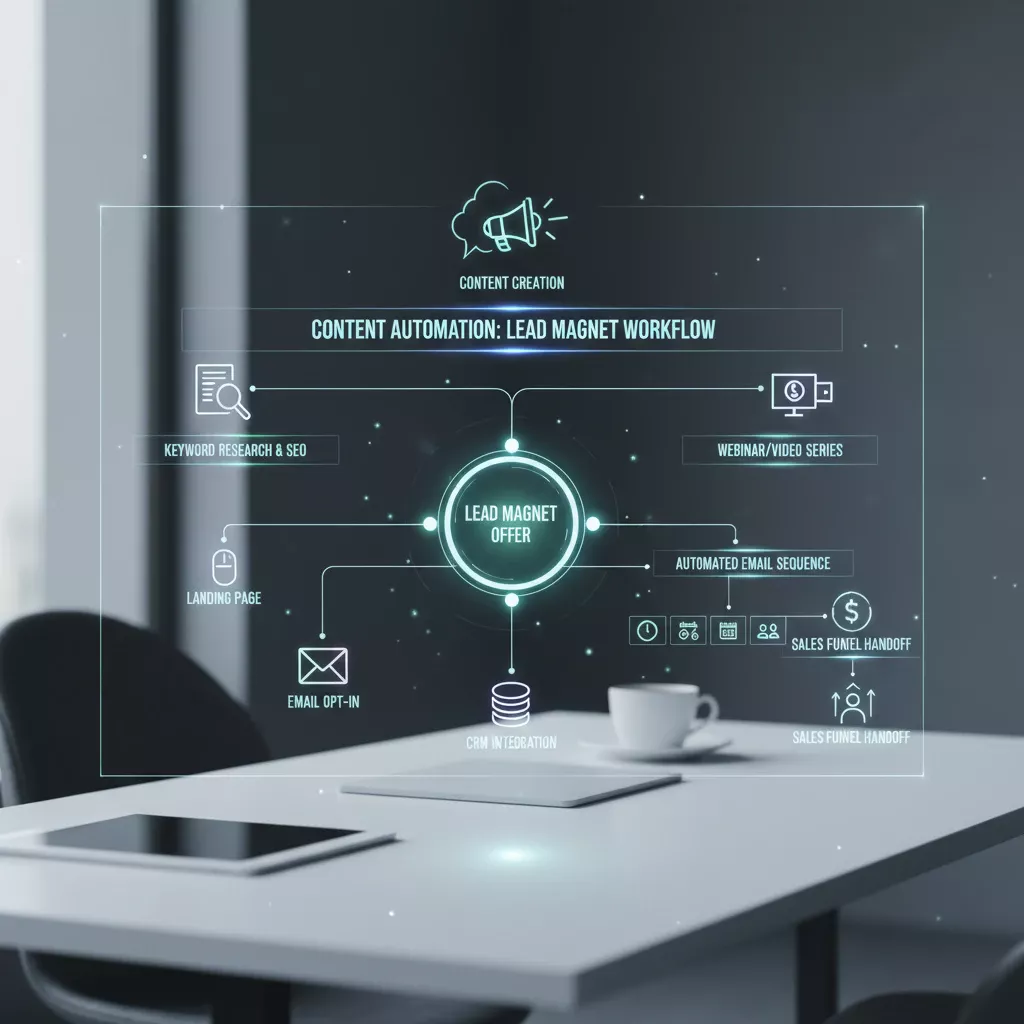
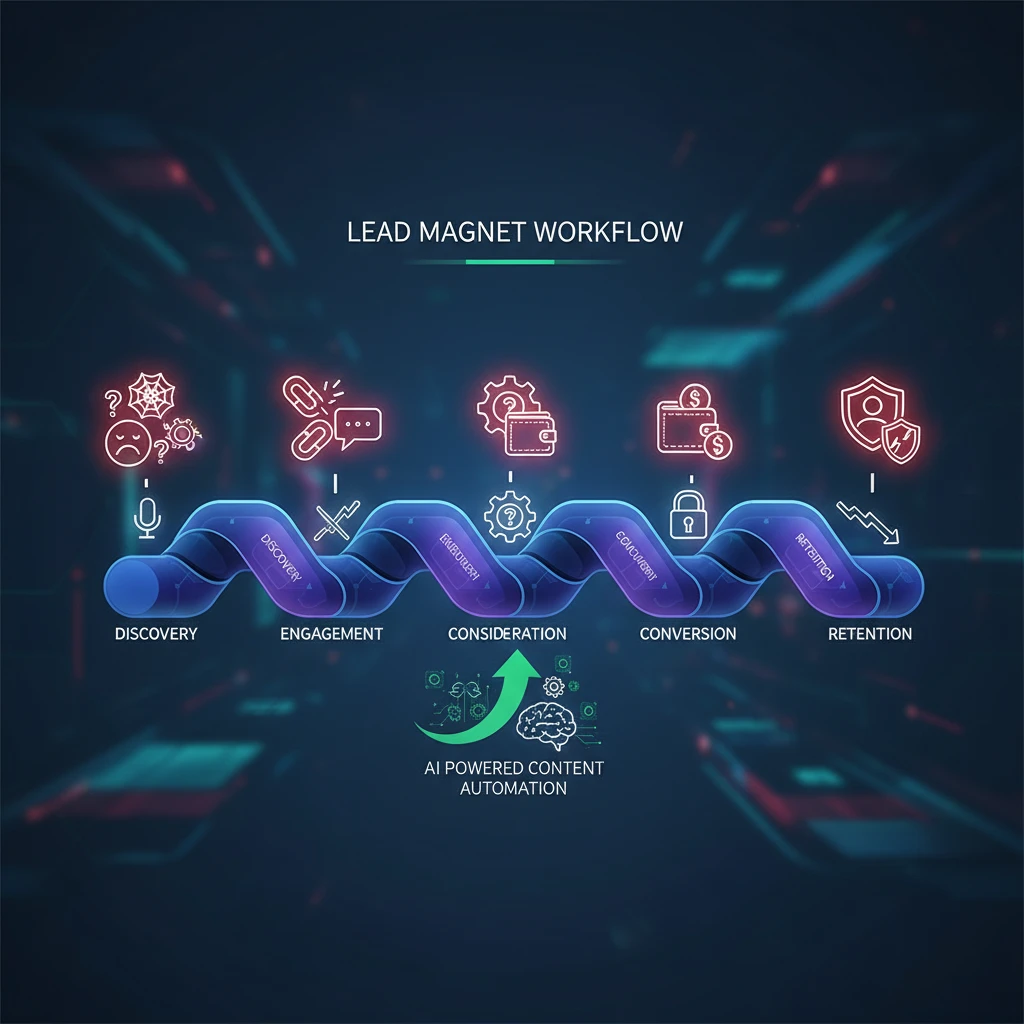
An effective automated lead magnet funnel is a carefully orchestrated sequence designed to guide potential customers from initial awareness to becoming qualified leads. It begins with attracting the right audience to your content, then seamlessly offering a valuable lead magnet, and finally, engaging them post-download to foster further interest and build trust. This systematic approach ensures that every interaction is purposeful, maximizing the conversion potential of your content marketing efforts. By understanding each stage of this funnel, businesses can optimize their processes to capture more leads and nurture them more effectively, turning passive readers into active prospects.
Triggering Content Consumption: SEO-Optimized Article Publishing
The genesis of any successful lead magnet funnel lies in attracting relevant organic traffic. This is achieved through the consistent publishing of SEO-optimized content that directly answers the questions and addresses the needs of your target audience. By focusing on relevant keywords and providing comprehensive, high-quality information, your articles will rank higher in search engine results, drawing in a steady stream of qualified visitors. This initial engagement is critical; the content must be compelling enough to hold the reader’s attention and demonstrate expertise. Consider how integrating AI tools can help you identify under-served topics and optimize your content for search intent. A robust content strategy, powered by intelligent automation, ensures that your articles act as the primary entry point for your lead generation funnel, consistently bringing new, interested prospects to your digital doorstep. This aligns with the core principles of driving organic traffic through strategic content, as detailed in resources like AI Content Automation: Drive Organic Traffic.
The Instant Value Offer: Delivering Your Lead Magnet Seamlessly
Once a user is engaged with your content, the next crucial step is to present them with a compelling lead magnet. This offer should be contextually relevant to the content they are consuming. For example, if they are reading about advanced SEO techniques, offer a downloadable checklist for SEO audits or a template for competitor analysis. The delivery mechanism must be seamless and friction-free. Instead of a separate landing page that requires multiple clicks, consider embedding the lead magnet offer directly within the blog post, perhaps as a pop-up that appears after a certain scroll depth or time spent on the page, or even a section at the end of the article. The goal is to make it incredibly easy for the user to say “yes” to the offer. This instant value exchange is where many funnels falter, so optimize for immediate access to the promised resource.
Post-Download Engagement: Nurturing the New Lead
The download of a lead magnet is not the end goal; it’s the beginning of a relationship. Immediately after a prospect provides their contact details, an automated nurturing sequence should kick in. This sequence should aim to provide further value, build trust, and guide the lead towards becoming a sales-qualified prospect. A typical flow includes an immediate thank-you email with a link to the downloaded resource, followed by a series of emails that offer related content, case studies, testimonials, or insights into your products/services. This approach keeps your brand top-of-mind and demonstrates your commitment to helping them solve their problems. Regularly auditing your nurture sequences ensures they remain relevant and effective, adapting to user engagement and evolving market needs. For continuous improvement, insights from content audits, such as those found in Content Audits: AI-Powered SEO Strategy 2027, can inform your post-download engagement strategies.
Automated Lead Magnet Delivery Mechanisms: Beyond Basic Forms
Moving beyond rudimentary contact forms, modern automation platforms enable sophisticated methods for delivering lead magnets that significantly enhance the user experience and lead quality. These mechanisms leverage user behavior and data to personalize offers and streamline the entire process, ensuring that the right lead magnet reaches the right prospect at the most opportune moment. By embracing these advanced delivery strategies, businesses can achieve higher conversion rates and cultivate more engaged leads, making their marketing efforts far more effective and efficient.
Dynamic Content Offers Based on User Behavior
Static lead magnet offers can be a missed opportunity. Implementing dynamic content allows you to tailor the lead magnet presented based on a visitor’s behavior on your site. For instance, a user who has read multiple articles on social media marketing might be offered an advanced social media strategy template, whereas a user who has explored e-commerce topics could be presented with an e-commerce conversion optimization guide. This personalization makes the offer feel more relevant and valuable, dramatically increasing the likelihood of a download. This can be achieved through website personalization tools that track user journeys and segment visitors in real-time. By analyzing user interactions, you can dynamically serve the most appropriate lead magnet, fostering a more targeted and effective lead capture process.
Instant Email Delivery with Personalized Follow-ups
The moment a user submits their information for a lead magnet, they expect instant gratification. Automated systems excel at providing this, delivering the requested resource via email immediately. But the automation doesn’t stop there. This initial delivery serves as the trigger for a personalized follow-up sequence. These follow-up emails can be tailored based on the specific lead magnet downloaded, the user’s industry, or their interaction with previous emails. For example, if a user downloads a guide on AI for content creation, the subsequent emails could highlight case studies of businesses using AI for content, offer related blog posts, or invite them to a webinar on advanced AI content strategies. This consistent, personalized communication nurtures the lead, builds trust, and keeps your brand top-of-mind without manual intervention.
Integrating with CRM and Marketing Automation Platforms
The true power of automated lead magnet delivery is unlocked when integrated with your Customer Relationship Management (CRM) and broader marketing automation platforms. When a lead magnet is downloaded and their information captured, it should be automatically passed into your CRM. This ensures that sales teams have immediate access to lead data, including which lead magnet they downloaded and when. Marketing automation platforms can then orchestrate more complex nurturing workflows, segmenting leads based on their engagement, scoring them, and triggering sales alerts when leads reach a certain qualification threshold. This seamless integration creates a unified view of the customer journey, enabling more efficient lead management and sales follow-up, and is a cornerstone of successful content systems. It ensures that every lead generated contributes effectively to your business growth objectives.
Crafting Compelling Lead Magnet Offers That Drive Sign-Ups
Developing lead magnets that genuinely attract and convert requires a strategic approach, moving beyond generic downloads. The core objective is to offer something of substantial perceived value that directly addresses a significant problem or aspiration of your target audience. When considering what to create, think about the immediate needs and challenges your ideal customer faces. A well-crafted lead magnet acts as a powerful first impression, demonstrating your expertise and the potential benefits of engaging further with your brand. In today’s competitive digital landscape, generic checklists or simple PDFs often fall flat. Instead, focus on providing actionable insights, tangible tools, or transformative knowledge that prospects can immediately implement to see a positive outcome. This approach not only drives higher sign-up rates but also attracts more qualified leads who are genuinely interested in the solutions you offer. A strong lead magnet should be a direct gateway to solving a specific problem your audience is actively searching for solutions to, making it an indispensable asset for any effective lead generation workflow.
Identifying Audience Pain Points for Offer Ideation
The bedrock of any successful lead magnet is a deep understanding of your audience’s most pressing pain points. This isn’t about guessing; it’s about diligent research and empathy. Begin by analyzing customer feedback, support tickets, and sales call transcripts to pinpoint recurring challenges, frustrations, and unmet needs. Tools like social listening platforms can provide real-time insights into what your audience is discussing online. Competitor analysis also offers valuable clues; what problems are your competitors successfully solving with their lead magnets, and where are there gaps? Consider your ideal customer persona and walk through their day, identifying points of friction. For example, a SaaS founder might struggle with scaling customer support without increasing headcount, creating an opportunity for a lead magnet on AI-powered support automation. Similarly, a content marketer might be overwhelmed by the sheer volume of content required, pointing towards a need for efficient content systems. By focusing on these specific pain points, you can ideate lead magnets that are not just attractive, but indispensable.
Types of Lead Magnets That Resonate in 2026: Checklists, Templates, and Mini-Courses
As the digital marketing landscape evolves, so too do the expectations for lead magnets. In 2026, highly practical, actionable, and easily digestible formats tend to perform best. Checklists remain effective when they are highly specific and actionable, breaking down a complex process into simple, manageable steps. For instance, a “Pre-Launch SEO Checklist for New Websites” is far more valuable than a generic “SEO Checklist.” Templates, such as pre-designed social media graphic templates, email copy frameworks, or budgeting spreadsheets, offer immediate utility and save recipients significant time and effort. They provide a tangible starting point for their own projects. Mini-courses, delivered via email sequences or a private landing page, cater to audiences seeking deeper knowledge without a major time commitment. These can cover topics like “5 Days to a More Engaging LinkedIn Profile” or “Introduction to AI-Powered Keyword Research.” The key is to ensure these formats offer clear, demonstrable value and a quick win for the user, making them an effective part of your content automation for driving traffic efforts.
Ensuring Lead Magnet Value Exceeds Expectations
The perceived value of a lead magnet is paramount to its success. To ensure your offer not only meets but exceeds expectations, focus on delivering tangible results and actionable insights. Avoid superficial content; instead, aim to provide a solution that is immediately implementable and offers a clear benefit. For example, a template should be professionally designed and include clear instructions for use, not just a blank structure. A checklist should offer expert tips and best practices alongside the steps. A mini-course should deliver genuine learning outcomes, perhaps through a combination of video snippets, actionable exercises, and downloadable resources. Consider the principle of “delight”: how can you surprise and impress your lead beyond what they anticipate? This might involve including bonus resources, offering a limited-time discount on a related product, or providing a personalized touch. High-value lead magnets foster trust and position you as a credible authority, making prospects more receptive to your future offerings and contributing to better content ROI.
The Technology Stack for an End-to-End Automated Lead Magnet System
Building an effective automated lead magnet workflow relies on a cohesive technology stack that streamlines every stage, from creation to nurturing. This system should minimize manual intervention while maximizing efficiency and personalization. At its core, an end-to-end solution integrates tools for content generation, distribution, lead capture, and follow-up. The goal is to create a seamless experience for both the user and the business. This means ensuring that each component of the stack can communicate effectively with the others. For instance, when someone downloads a lead magnet, the system should automatically add them to a relevant email sequence and update their profile in the CRM. This interconnectedness is crucial for scaling lead generation efforts without a proportional increase in human resources. A well-integrated stack allows for sophisticated automation, enabling you to deliver the right content to the right person at the right time, a key aspect of future-proofing content with AI automation.
Content Generation and SEO Optimization Tools
The foundation of any lead magnet strategy is the content itself. Leveraging AI-powered tools can significantly enhance both the creation and optimization process. For content generation, platforms like SEO45 AI can assist in brainstorming ideas, drafting content for ebooks, guides, or checklists, and ensuring a consistent tone and quality. These tools help overcome writer’s block and accelerate production. Equally important is SEO optimization, ensuring your lead magnet content is discoverable by your target audience. This involves keyword research to understand what terms potential leads are searching for, optimizing meta descriptions and titles, and structuring content for readability and search engine understanding. Tools that analyze top-ranking content can provide insights into what resonates with both search engines and users, helping you create lead magnets that not only attract but also rank. Integrating these tools into your workflow ensures that your lead magnets are not only valuable but also discoverable through organic search.
Landing Page and Form Builders with Automation Capabilities
Once your lead magnet is ready, the next critical step is capturing leads effectively. This is where landing page and form builders with robust automation capabilities come into play. These tools allow you to create dedicated, high-converting landing pages specifically for your lead magnets, free from the distractions of your main website navigation. Key features to look for include A/B testing capabilities for optimizing page elements, mobile responsiveness, and customizability to match your brand. Crucially, these builders should integrate seamlessly with your CRM and email marketing platforms. This integration enables automatic lead assignment, segmentation, and the triggering of post-download workflows. For example, a user filling out a form for an ebook should be automatically tagged in your CRM and enrolled in a welcome email sequence. Look for platforms that offer advanced logic and conditional fields to personalize the lead capture experience, thereby improving data quality and relevance.
Email Marketing and CRM Integration for Lead Nurturing
The true power of an automated lead magnet system unfolds in the lead nurturing phase, which begins immediately after a download. Seamless integration between your landing page/form builder, email marketing platform, and Customer Relationship Management (CRM) system is essential. Upon form submission, the lead should be automatically entered into your CRM and segmented based on the lead magnet they downloaded or any other criteria captured. This allows for highly targeted email sequences. An email marketing platform can then deliver personalized follow-up content, educational resources, and eventual offers, guided by the lead’s initial interest. For instance, if a lead downloaded a guide on SEO basics, your automation should trigger a series of emails expanding on SEO topics, potentially leading to a demo of an AI content automation tool designed to increase website traffic. This continuous engagement and value delivery is key to moving leads through the sales funnel and building lasting relationships.
Measuring the ROI of Your Automated Lead Magnet Workflows
To justify investment and continuously improve your lead generation efforts, it’s crucial to establish robust methods for measuring the Return on Investment (ROI) of your automated lead magnet workflows. This involves tracking specific metrics that demonstrate the financial impact of your lead magnet campaigns. Beyond just the number of leads generated, you need to understand the quality of those leads and the cost associated with acquiring them. By systematically analyzing performance data, you can identify which lead magnets are performing best, which channels are most effective for distribution, and where opportunities exist for optimization. This data-driven approach ensures that your resources are allocated effectively, focusing on strategies that yield the highest returns and contribute directly to business growth. Effective measurement is the cornerstone of any scalable and profitable AI strategy for startup growth.
Key Performance Indicators: Conversion Rates, Lead Quality, and Cost Per Lead
Several key performance indicators (KPIs) are vital for assessing the effectiveness of your automated lead magnet workflows. Conversion rates are fundamental – this measures the percentage of visitors who download your lead magnet after landing on the page. A low conversion rate might indicate issues with the offer itself, the landing page design, or the traffic quality. Lead quality is equally, if not more, important than quantity. This can be measured by tracking how many leads progress to subsequent stages of the sales funnel, become marketing-qualified leads (MQLs), or sales-qualified leads (SQLs), and ultimately convert into paying customers. A high volume of low-quality leads can skew perceived success. Finally, Cost Per Lead (CPL) is crucial for ROI calculation. This is determined by dividing the total marketing spend allocated to a specific lead magnet campaign (including ad spend, content creation costs, and tool subscriptions) by the number of leads generated. Monitoring these KPIs provides a clear picture of your campaign’s efficiency and profitability.
A/B Testing Elements of Your Workflow for Continuous Improvement
Continuous improvement is the hallmark of successful marketing automation. A/B testing is an indispensable tool for optimizing every element of your lead magnet workflow. Start by testing variations of your landing pages: different headlines, calls-to-action (CTAs), imagery, and form layouts. Even minor changes can significantly impact conversion rates. Beyond the landing page, test different lead magnet offers themselves to see which resonates most with your audience. Experiment with different email subject lines and content in your follow-up sequences to improve open rates and click-through rates. The goal is to systematically identify what works best through data-driven experimentation. For example, testing a video-based mini-course against a PDF checklist can reveal preferences in content consumption. By iteratively testing and refining each component, you ensure that your automated system becomes increasingly effective at attracting and converting leads over time.
Attributing Lead Generation Success to Specific Content Assets
Accurate attribution is essential for understanding which lead magnets are truly driving business value. Without proper attribution, it’s difficult to allocate resources effectively or identify your most impactful content assets. Implement a clear tracking system that links leads directly back to the specific lead magnet they downloaded. This often involves using unique tracking URLs, UTM parameters, or leveraging the built-in attribution features of your marketing automation or CRM platform. Once leads are in your system, track their journey through the funnel. Which lead magnets result in the highest conversion rates to MQLs, SQLs, and ultimately, customers? Analyzing this data allows you to identify your “hero” lead magnets – those that consistently attract high-quality leads and contribute significantly to revenue. This insight is invaluable for informing future content creation and marketing strategies, such as those explored in competitor analysis using AI for strategic content gaps.
Common Pitfalls to Avoid in Automated Lead Magnet Strategy
While the allure of automation is strong, businesses can fall into several traps that undermine the effectiveness of their lead magnet strategies. These pitfalls often stem from a misunderstanding of automation’s purpose, which is to enhance, not replace, genuine human connection and value delivery. Over-reliance on technology without strategic oversight can lead to impersonal experiences that alienate prospects. Similarly, offering low-value content under the guise of a lead magnet can damage brand reputation and attract unqualified leads. Finally, neglecting the crucial post-download phase, where nurturing and follow-up occur, means leaving significant potential on the table. Avoiding these common mistakes is vital for building a sustainable and profitable lead generation engine that fosters long-term customer relationships rather than just short-term downloads.
Over-Automation Leading to Impersonal Experiences
A common pitfall is the tendency to automate every single interaction to an extreme, resulting in an impersonal and robotic experience for the prospect. While automation is designed to improve efficiency, it should not come at the cost of genuine connection. When automated emails sound generic, lack personalization beyond a first name, or fail to address specific user needs, they can feel intrusive or irrelevant. For instance, sending a generic “thank you for downloading” email that doesn’t acknowledge the specific content downloaded, or immediately bombarding prospects with sales pitches without providing further value, can be counterproductive. The key is to use automation to deliver relevant, timely information and offers based on user behavior and stated interests, while still incorporating human-like language and a focus on problem-solving. It’s about scaling connection, not eliminating it, ensuring that your automated system complements, rather than replaces, the human touch.
Low-Value Lead Magnets That Alienate Prospects
Creating lead magnets that offer minimal real value is a sure way to alienate potential customers and damage your brand’s credibility. Prospects are trading their contact information for something they perceive as valuable, and if that “something” is superficial, poorly executed, or doesn’t solve a real problem, they will feel misled. This can lead to immediate unsubscribes, negative word-of-mouth, and a general distrust of your brand. Avoid lead magnets that are merely thinly veiled sales pitches, contain outdated or inaccurate information, or are too broad to be actionable. Instead, focus on delivering depth and practical utility. For example, a checklist should be comprehensive and offer expert tips, not just a few bullet points. A template should be well-designed and include clear instructions. When a lead magnet truly helps the prospect achieve a small win, it builds trust and opens the door for future engagement, fostering a positive relationship that can lead to conversions, as detailed in discussions about AI-powered user segmentation for tailored experiences.
Ignoring Post-Download Nurturing and Follow-Up Sequences
Many businesses focus heavily on the initial download of a lead magnet but then fail to capitalize on the opportunity by neglecting post-download nurturing. This is a critical mistake, as the user has just demonstrated a clear interest in a specific topic. Ignoring this engagement window means leaving potential leads to go cold and diminishing the ROI of your lead magnet creation efforts. A well-designed follow-up sequence should continue to provide value, educate the prospect, build trust, and gently guide them towards a deeper relationship with your brand. This could involve sending related content, case studies, webinars, or tailored offers based on their initial interest. Without consistent follow-up, the lead magnet becomes a one-time interaction, failing to move the prospect further down the marketing funnel and ultimately hindering revenue growth.
Optimizing Lead Magnet Workflows for SEO and User Experience
A well-optimized lead magnet workflow is crucial for attracting and converting visitors. This involves ensuring your landing pages are not only compelling but also discoverable by search engines and user-friendly across all devices. The initial interaction point, the lead magnet landing page, sets the tone for the entire user journey. To maximize its effectiveness, focus on clear value propositions, concise copy, and a straightforward call to action. Avoid overwhelming visitors with too much information; instead, highlight the benefits they will receive by opting in. This clarity helps in reducing bounce rates and increasing conversion opportunities. Furthermore, understanding how search engines crawl and rank pages is vital for organic visibility. Implementing SEO best practices on your landing pages ensures that potential leads searching for solutions your lead magnet offers can actually find it.
Ensuring Lead Magnet Landing Pages are Search Engine Discoverable
To make your lead magnet landing pages easily discoverable by search engines, several key elements must be in place. Begin with meticulous keyword research to identify terms your target audience uses when searching for the problems your lead magnet solves. Incorporate these keywords naturally within your page’s title tags, meta descriptions, headings (H1, H2, etc.), and body content. The title tag should be compelling and accurately reflect the page’s content and the lead magnet’s value, while the meta description serves as a brief advertisement in search results. High-quality, relevant content that directly addresses user intent is paramount; search engines favor pages that provide comprehensive answers and solutions. Ensure your landing pages have a clear structure with logical headings and sufficient content depth, but always prioritize readability. Implementing schema markup can further help search engines understand your page’s content, potentially leading to rich snippets in search results. Remember that page load speed is a critical ranking factor, so optimize images, leverage browser caching, and minimize code to ensure your landing pages load quickly on all connections. Regularly performing content audits can identify areas for improvement in discoverability and relevance.
Mobile-First Design for Lead Capture Forms
With a significant portion of web traffic originating from mobile devices, a mobile-first design for your lead capture forms is no longer optional but essential. This approach prioritizes the user experience on smaller screens, ensuring that forms are easy to view, understand, and complete without excessive scrolling or pinching. Forms should feature large, tappable fields, clear labels positioned above or to the left of the input area, and generously spaced buttons. Avoid using tiny fonts or complex layouts that are difficult to navigate on a smartphone. Input fields should ideally utilize the most appropriate mobile keyboard type (e.g., numeric for phone numbers, email for email addresses). Consider incorporating progressive profiling, where you ask for minimal information initially and gradually collect more details as the user engages further with your brand. This reduces initial friction and improves conversion rates on mobile. A well-designed mobile form not only enhances user experience but also contributes positively to your site’s overall mobile usability, which is a factor in search engine rankings. For a deeper dive into user segmentation for optimal content delivery, explore website content: AI-powered user segmentation.
Balancing Automation with Genuine Human Connection
While automation is the cornerstone of efficient lead magnet workflows, striking a balance with genuine human connection is vital for building trust and fostering long-term relationships. Over-automation can feel impersonal and may alienate potential leads. Implement automation for repetitive tasks like email nurturing sequences, lead scoring, and data segmentation, but ensure there are points of human interaction. This could involve offering live chat support on landing pages, personalized follow-up emails that genuinely address user needs, or even a quick personal call for high-value leads. The goal is to use automation to scale your efforts, not to replace meaningful engagement entirely. Think of automation as a powerful tool that frees up your team to focus on higher-value interactions. For instance, after a lead downloads a guide, an automated email can deliver the resource and offer related content. However, if the lead shows a strong interest in a specific topic, a manual, personalized follow-up from a sales representative can be far more effective than another automated message. Authenticity in your communication, even within automated sequences, can significantly improve conversion rates and customer loyalty.
Case Study: A SaaS Company’s Success with Automated Lead Magnet Campaigns
A hypothetical SaaS company, “Innovate Solutions,” specializing in project management software, faced challenges with inconsistent lead generation. They implemented a multi-faceted lead magnet strategy supported by automation to address this. Initially, they developed three distinct lead magnets: an industry-specific ebook titled “Streamlining Workflow for Marketing Teams,” a webinar on “Agile Project Management Best Practices,” and a downloadable template for “Budget Planning.” Their workflow began with targeted social media ads and blog post promotions driving traffic to dedicated landing pages for each lead magnet. Upon form submission, leads were automatically added to specific nurturing sequences based on the lead magnet downloaded. For the ebook, a sequence provided immediate access and followed up with related blog post links and a soft invitation to a product demo. The webinar participants received follow-up emails with a recording and advanced feature highlights. Template users received a series of emails demonstrating how the template could be integrated into their project management process, with a clear path to a free trial. Lead scoring was implemented, increasing scores for actions like demo requests or visiting pricing pages. This automation allowed their small marketing team to manage a significantly higher volume of leads without compromising personalization. Within six months, they observed a 40% increase in qualified leads and a 25% improvement in conversion rates to trial sign-ups. This success underscored the power of tailored lead magnets and intelligently automated nurturing, a strategy that can be explored further through AI content automation for lead gen workflows.
Future-Proofing Your Lead Generation: The Role of AI in Workflow Evolution
The landscape of lead generation is constantly evolving, and artificial intelligence (AI) is set to play an increasingly pivotal role in future-proofing your workflows. AI-powered tools can analyze vast amounts of data to identify emerging trends, predict user behavior, and personalize lead nurturing at an unprecedented scale. This allows for the creation of highly relevant and timely lead magnets, delivered through hyper-personalized channels. AI can assist in not only generating the lead magnet content itself but also in optimizing its distribution and the subsequent engagement strategy. For example, AI can dynamically suggest which lead magnet is most likely to resonate with a specific visitor based on their browsing history and demographic data. Furthermore, AI can automate the process of competitor analysis, identifying content gaps that your lead magnets can fill. Predictive analytics can help forecast which leads are most likely to convert, allowing your sales team to prioritize their efforts effectively. By integrating AI, you move beyond static workflows to a dynamic, self-optimizing system that continuously adapts to market changes and user preferences. This proactive approach ensures your lead generation efforts remain effective and efficient in the long term, aligning with the broader strategy of future-proofing your content with AI automation. The continuous evolution of AI means that staying informed about its latest applications in content systems is key to maintaining a competitive edge.
By embracing these advanced strategies, businesses can create lead magnet workflows that are not only effective today but also resilient and adaptable for the future.