

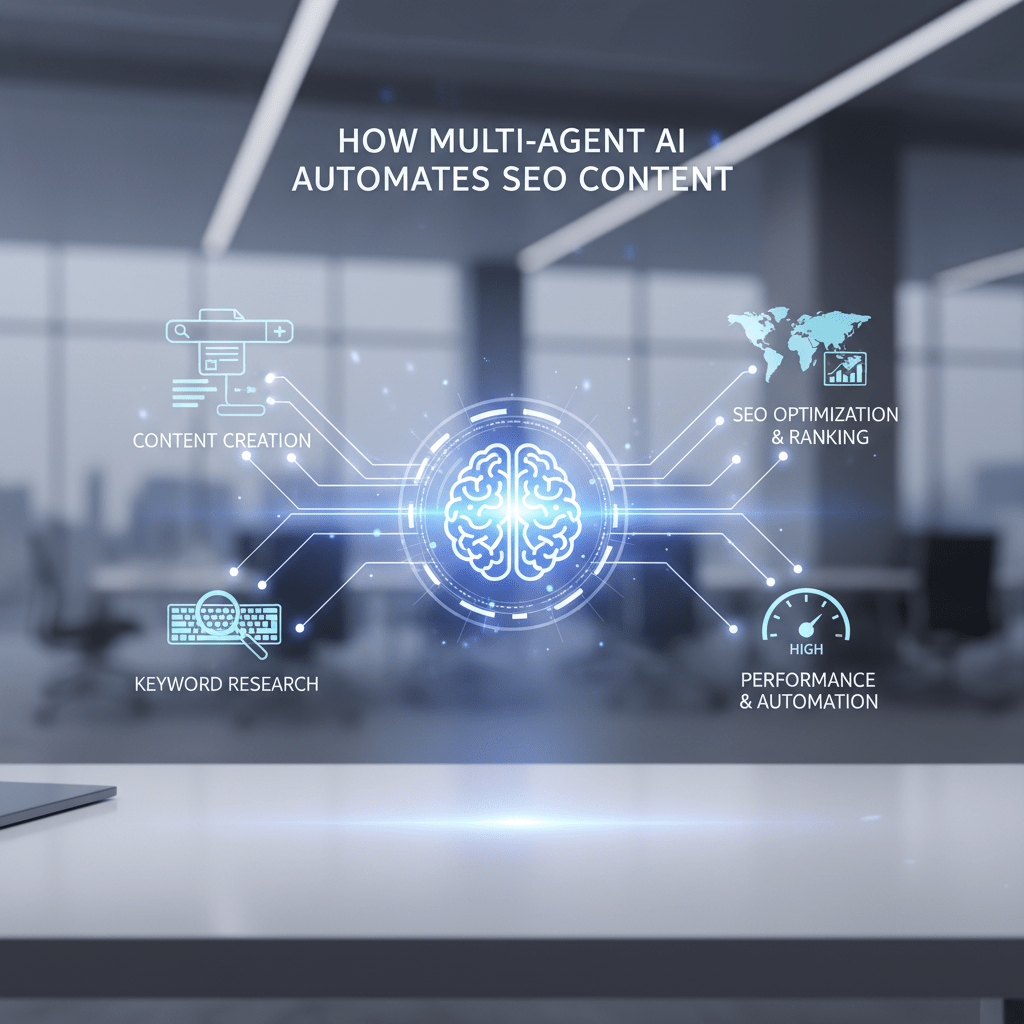
The demand for high-quality, SEO-optimized content is a relentless engine for growth. Yet, for most businesses, the content creation process is a fragmented, time-consuming, and expensive ordeal. Managing in-house writers, coordinating with freelancers, or paying hefty agency retainers creates a significant bottleneck that slows down scalability. While single-prompt AI tools have offered a glimpse of a solution, they often require constant human intervention, producing generic content that fails to rank. This is where a more sophisticated paradigm emerges: the multi-agent AI system, a technology designed not just to assist in content creation, but to automate the entire workflow from end to end.
This article will explore the architecture of multi-agent AI systems and detail how they systematically deconstruct and automate every stage of the SEO content lifecycle. We’ll move beyond the simple concept of AI writing and into the realm of autonomous, collaborative AI teams that can research, write, optimize, and publish content at a scale previously unimaginable.
Beyond the Single Prompt: Understanding Multi-Agent AI
To grasp the power of a multi-agent system, it’s essential to first understand the limitations of its predecessor. The current generation of widely available AI writing tools operates on a single-agent model. You provide a prompt, and the AI provides a response. While impressive, this is a fundamentally reactive process that requires a human to perform all the strategic work that surrounds the writing itself.
The Old Way: The Limits of Single-Agent AI
A single-agent AI, like a standard chatbot, is analogous to a talented but inexperienced intern. It can execute a specific, well-defined task, but it lacks broader context and strategic awareness. Its limitations are clear in the content creation workflow:
- Lack of Statefulness: The AI doesn’t remember the strategic goals from one task to the next. The keyword research you did is separate from the outline you create, which is separate from the draft you write.
- Requires Constant Human Direction: A human must act as the project manager, feeding the AI specific instructions at every step—researching keywords, analyzing competitors, generating an outline, drafting each section, and then optimizing the final text.
- Inconsistent Quality: The output’s quality is entirely dependent on the user’s ability to write highly detailed and effective prompts. This leads to variability and often requires significant editing.
- No True Automation: It’s a tool for assistance, not automation. The human remains the bottleneck, responsible for every strategic decision and transition between tasks.
The New Paradigm: How Multi-Agent Collaboration Works
A multi-agent AI system is an ecosystem of specialized, autonomous AIs—or “agents”—that collaborate to achieve a complex objective. Instead of one generalist AI, you have a dedicated team where each member has a distinct role. Think of it as a digital content agency operating in perfect sync, 24/7.
These systems are built on three core principles:
- Specialization: Each agent is fine-tuned for a specific function. There’s a Keyword Research Agent, a SERP Analysis Agent, a Content Writing Agent, an SEO Optimization Agent, and even a Publishing Agent. Each is an expert in its domain.
- Collaboration: This is the critical differentiator. Agents communicate and pass information seamlessly. The output from the Research Agent becomes the direct input for the Outline Agent, whose work then guides the Writing Agent. This creates a continuous, context-aware workflow.
- Autonomy: Once a high-level goal is set (e.g., “Write a comprehensive article on ‘multi-agent AI for SEO'”), the system can execute the entire sequence of tasks with minimal to no human intervention.
From Keyword to Published Post: The Multi-Agent Workflow in Action
To truly appreciate the power of this approach, let’s walk through the entire SEO content lifecycle and see how a multi-agent system like SEO45 AI automates every step.
Step 1: The Research and Strategy Agents
Effective SEO content begins with deep, data-driven research. A multi-agent system deploys specialized agents to build a comprehensive strategic foundation before a single word is written.
- Keyword Analyst Agent: This agent goes beyond simple keyword discovery. It identifies a primary target keyword and a cluster of semantically related long-tail keywords. It analyzes search volume, keyword difficulty, and, most importantly, user intent (informational, commercial, transactional).
- SERP Analysis Agent: To rank, you must understand the competitive landscape. This agent meticulously analyzes the top-ranking pages for the target keyword. It extracts crucial data points like common subheadings, content structures, word count averages, prominent entities, and questions featured in the “People Also Ask” section. This process of comprehensive SERP analysis ensures the resulting content is structured to meet and exceed what Google already rewards.
- Audience Persona Agent: This agent synthesizes data to define the target reader. Is the audience a beginner seeking basic information or an expert looking for technical details? This informs the content’s tone, depth, and vocabulary, ensuring it resonates with the intended reader.

Step 2: The Content Structuring and Writing Agents
With a solid strategic brief compiled by the research agents, the next set of agents takes over to architect and draft the article.
- Outline Generation Agent: This agent uses the SERP analysis and keyword data to construct a detailed, SEO-friendly outline. It maps out the H2s, H3s, and H4s, ensuring a logical flow while incorporating key topics and questions that users are searching for.
- Drafting Agent: Working section by section from the approved outline, this agent writes the body of the article. Because it has the full context from the research phase, it can produce highly relevant, factual, and engaging prose that directly addresses user intent. It’s not just generating text; it’s fulfilling the strategic brief.
- Internal Linking Agent: To build topical authority and improve site navigation, this agent scans the website’s existing content to identify relevant internal linking opportunities. It intelligently suggests anchor text and destination pages, strengthening the site’s overall SEO structure.
Step 3: The Optimization and Editing Agents
A raw draft is rarely ready for publication. The next phase involves a rigorous process of refinement and optimization, handled by another team of specialist agents.
- SEO Optimization Agent: This agent acts as a digital SEO specialist, cross-referencing the draft against the initial research. It ensures optimal keyword density, checks for the inclusion of LSI (Latent Semantic Indexing) keywords, optimizes the title tag and meta description, and verifies that the content comprehensively covers the topic.
- Editing and Proofreading Agent: Going beyond simple spell-checking, this agent refines the text for clarity, grammar, and style. It improves readability by simplifying complex sentences, correcting punctuation, and ensuring the tone is consistent with brand guidelines.
- Fact-Checking Agent: For topics that require high accuracy, an advanced fact-checking agent can be deployed. It cross-references statistics, claims, and data points against authoritative external sources, flagging potential inaccuracies before publication.
Step 4: The Publishing and Formatting Agents
The final step is getting the content from a finished document onto the website. This final leg of the journey is also automated.
- CMS Formatting Agent: This agent converts the final text into clean HTML, correctly formatting headings, lists, bold text, and other elements. It can be configured to prepare content for specific platforms like WordPress or Webflow.
- Image Sourcing Agent: Where needed, this agent can search royalty-free image libraries for visuals that are relevant to the content. It can even generate optimized file names and draft descriptive alt text for accessibility and image SEO.
- Publishing Agent: This agent connects directly to your content management system (CMS) via an API. It can upload the formatted article, add images, set the publication date, assign categories and tags, and either publish it immediately or save it as a draft for final human review.
The Tangible Benefits: Speed, Scale, and Superior SEO
Adopting a multi-agent AI system fundamentally changes the economics and velocity of content marketing. The benefits go far beyond simply writing faster; it’s about building a more efficient, scalable, and effective content engine.
| Feature | Multi-Agent AI System | Human Agency / In-House Team | Single AI Writing Tool |
|---|---|---|---|
| Speed | Hours from concept to publish | Days or weeks | Faster drafting, but overall process is still slow |
| Scalability | Nearly infinite; can produce dozens of articles daily | Limited by headcount and budget | Limited by the user’s time and effort |
| Cost | Low, predictable subscription fee | High (salaries, retainers, overhead) | Low tool cost, but high “time cost” for the user |
| Consistency | Perfectly consistent quality and formatting | Varies by writer and editor | Varies based on user’s prompting skill |
| Autonomy | High; operates end-to-end with minimal input | None; requires constant management | None; it is a tool that requires a user |
Unprecedented Scale and Speed
Because the process is automated and runs in parallel, a multi-agent system can collapse a multi-week content cycle into a matter of hours. This allows businesses to scale their content production from a handful of articles per month to dozens or even hundreds, targeting a vast array of long-tail keywords without a proportional increase in costs or personnel.
Radical Cost Reduction and Efficiency
By automating the entire workflow, multi-agent systems eliminate the need for large in-house teams or expensive agency retainers. The cost per article plummets, allowing marketing budgets to be reallocated to other growth initiatives. The efficiency gains are immense, freeing up human strategists to focus on high-level planning rather than the day-to-day grind of content production.
Superior SEO and Consistency
Human variability is a major challenge in content creation. Different writers have different styles, and quality can fluctuate. A multi-agent system ensures that every single article is created following the exact same data-driven, SEO-centric process. The research is always thorough, the optimization is always on-point, and the formatting is always perfect. This consistency sends strong, clear signals to search engines, helping to build topical authority and improve rankings over time. This level of predictable, autonomous execution is the holy grail of scalable SEO.
The evolution from manual content creation to AI-assisted tools was the first step. However, the true revolution lies in full automation. Multi-agent AI systems represent a paradigm shift, moving from tools that help humans work to systems that work for humans. They function as a complete, always-on content engine, handling every tedious task from research to publishing. For businesses aiming to dominate search rankings and scale their digital presence, embracing this technology is no longer a futuristic concept—it’s a decisive competitive advantage available today.