

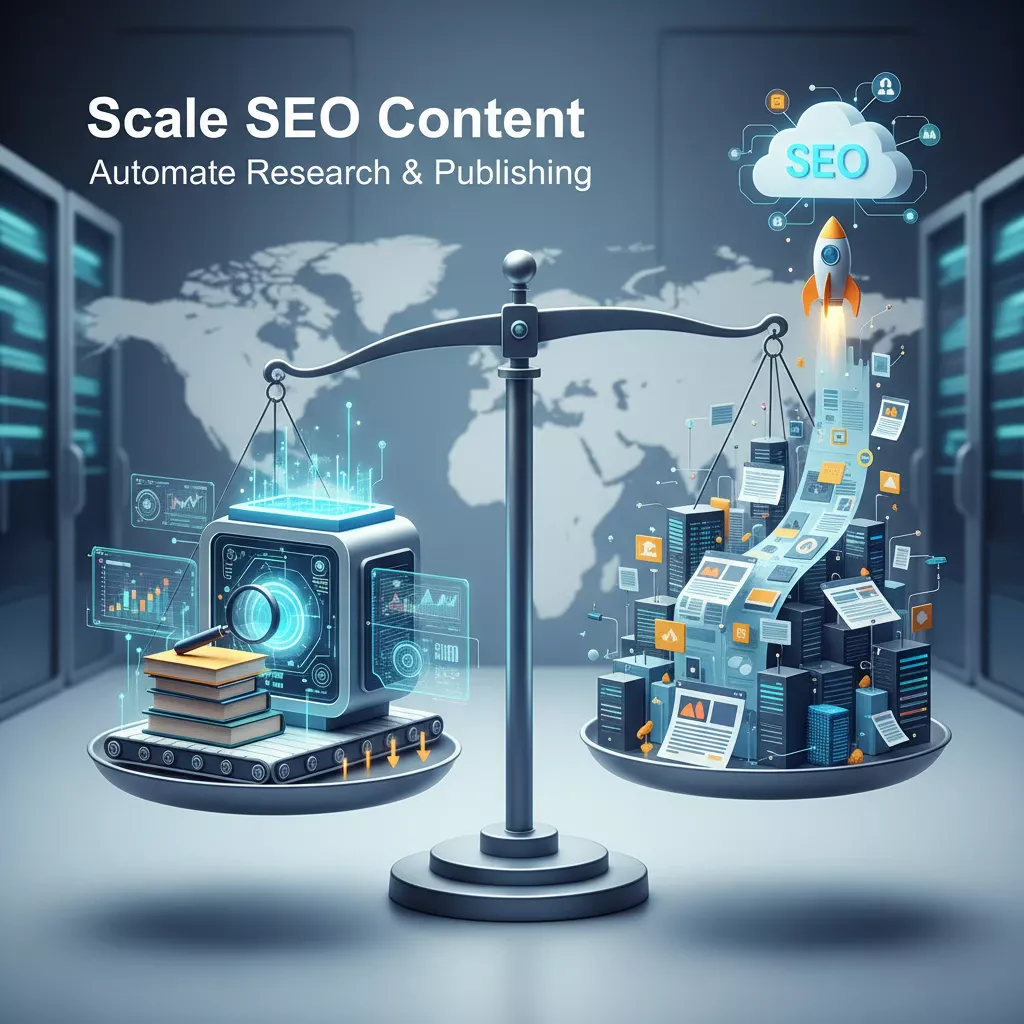
Achieving consistent organic growth in today’s competitive digital landscape hinges on the ability to publish high-quality, relevant content at scale. However, many businesses find themselves trapped by manual, time-consuming processes that hinder their ability to keep pace with search engine demands and audience expectations.
This section delves into the critical bottlenecks that prevent scalable SEO content creation and explores how automation, particularly AI-driven solutions, can transform these challenges into opportunities for sustained growth and market leadership.
The Bottleneck in Scalable SEO Content Creation: Beyond Manual Efforts
The aspiration for widespread organic visibility through content marketing is a common goal, yet the practical execution often falls short due to inherent inefficiencies in traditional methods. For businesses aiming to expand their digital footprint, the sheer volume of work involved in producing SEO-optimized articles becomes an immediate hurdle. Manual research, writing, editing, and publishing cycles are not only slow but also prone to human error and inconsistency. This lack of scalability directly impacts a company’s ability to react to market shifts, capitalize on emerging trends, or consistently serve audience needs. The reality in 2026 is that organizations must move beyond sporadic content bursts to establish a steady, high-volume output that search engines reward.
Understanding the limitations of traditional content workflows in 2026
Traditional content creation workflows are characterized by their sequential, often siloed, nature. A team might spend days, if not weeks, on a single piece of content: conceptualization, keyword research, outline creation, drafting, editing, on-page optimization, and finally, publishing. This linear progression is inherently limiting. By 2026, search algorithms are more sophisticated than ever, favoring fresh, comprehensive, and highly relevant content published with regularity. Manual workflows struggle to meet this demand, leading to diluted impact and missed opportunities. Furthermore, the reliance on individual expertise means that scaling output is directly tied to hiring more personnel, a costly and time-consuming endeavor, rather than investing in technology that can amplify existing resources. The goal is to move towards a more agile and responsive system that can adapt quickly to evolving search trends and user queries, a feat nearly impossible with purely manual operations.
Identifying the key time sinks in research and publishing
Within the traditional content lifecycle, several stages are notorious time sinks. Keyword research, while foundational, can involve sifting through vast amounts of data to identify relevant terms, analyze their search volume, and gauge competition. Subsequently, topic ideation requires brainstorming and validation, often without clear data-driven direction. The actual content drafting phase is labor-intensive, demanding significant human input to craft prose that is both engaging and informative. Then comes the detailed process of on-page optimization, including meta tag creation, internal linking, and image alt text. Finally, the publishing and distribution steps, while seemingly straightforward, add to the cumulative time spent. Each of these activities, when performed manually, consumes valuable hours that could otherwise be allocated to strategic planning or more complex creative tasks. These cumulative delays prevent a business from achieving the content velocity required for significant organic growth.
The direct impact of slow content cycles on organic growth
The repercussions of slow content production cycles on organic growth are multifaceted and significant. Search engines like Google prioritize websites that consistently provide fresh, valuable content. When a site publishes infrequently, it signals to search engines that it is less active and potentially less relevant. This can lead to lower rankings, reduced organic traffic, and a diminished ability to capture new audience segments. Furthermore, slow content cycles mean that a business is less agile in responding to emerging trends or competitor moves. Competitors who can publish more rapidly can quickly capture market share and relevant search queries before a slower competitor even has a chance to respond. This creates a widening gap in organic visibility and authority, making it increasingly difficult to catch up. Ultimately, slow content cycles translate directly into lost traffic, leads, and revenue, hindering the very growth that content marketing aims to achieve. Understanding this direct correlation is the first step toward embracing more efficient solutions.
Automating SEO Research: Unearthing Audience Intent at Scale
The bedrock of successful SEO content lies in a deep understanding of user intent and the strategic identification of relevant topics. Manual research, however, is a bottleneck. Automation, particularly through AI, offers a powerful solution by rapidly analyzing vast datasets, uncovering hidden patterns, and surfacing opportunities that would be impossible to discover manually. This allows for a more proactive, data-driven approach to content strategy, ensuring that every piece published is aligned with what your target audience is actively searching for. By leveraging these automated insights, businesses can move beyond guesswork and into a realm of precision, creating content that resonates deeply and ranks effectively.
Leveraging AI for advanced keyword clustering and topic ideation
AI excels at processing large volumes of data to identify relationships and patterns that are invisible to the human eye. For SEO research, this translates into sophisticated keyword clustering, where related search terms are grouped into thematic clusters. Instead of analyzing keywords individually, AI can identify overarching topics and sub-topics that users are interested in, revealing content opportunities that span multiple intent types. This is invaluable for topic ideation, as it moves beyond generic suggestions to reveal nuanced content pillars that address specific user needs. For instance, instead of just identifying “best running shoes,” AI might cluster this with “trail running shoes,” “waterproof running shoes for women,” and “running shoe reviews for flat feet,” suggesting a comprehensive content strategy that covers various facets of the initial broad query. This data-driven approach ensures that content development is not only efficient but also deeply aligned with audience search behavior.
Tools and techniques for identifying content gaps and competitor strategies
Automated SEO research tools can perform sophisticated content gap analysis by comparing a website’s existing content against competitor portfolios and broad topic landscapes. By ingesting data from search engine results pages (SERPs) and competitor websites, these tools can pinpoint areas where a business is underrepresented or entirely absent, while competitors are successfully ranking. This process is crucial for identifying strategic opportunities and potential content pillars that can drive new organic traffic. Furthermore, AI can automate the analysis of competitor content strategies, revealing their most successful topics, the keywords they rank for, and the structure of their high-performing articles. This intelligence allows for more informed strategic decisions, whether it’s creating content to directly challenge a competitor on a key topic or identifying adjacent niches they haven’t yet exploited. Tools that automate this competitive intelligence gathering are essential for maintaining a strategic advantage. For a deeper dive into this area, understanding AI’s role in strategic content gap analysis can provide valuable context.
Integrating search intent analysis into your automated research process
Understanding the underlying intent behind a search query is paramount for creating content that truly satisfies users and satisfies search engines. Automated research platforms can now integrate sophisticated search intent analysis directly into the workflow. This means not only identifying keywords but also classifying them into categories like informational (seeking knowledge), navigational (looking for a specific site), transactional (intending to buy), and commercial investigation (researching before purchase). By understanding these intents at scale, businesses can tailor their content topics and formats accordingly. For example, informational queries might best be served by in-depth blog posts or guides, while transactional queries might require product pages or comparison tables. Automating this intent classification ensures that all content ideation and keyword selection are grounded in a robust understanding of user needs, leading to higher engagement and better conversion rates. This integration is a cornerstone of an effective, automated SEO content strategy.
Streamlining Content Generation: From Draft to SEO-Ready Asset
Once research is automated, the next logical step is to streamline the content generation process itself. AI-powered writing assistants have evolved significantly, moving beyond basic text generation to create content that is not only grammatically sound but also optimized for search engines and reflective of brand voice. Automating the creation of essential meta elements and ensuring consistency across content pieces are critical for maintaining efficiency and quality at scale. This phase is about transforming raw ideas into polished, SEO-ready assets that can be published rapidly and effectively, significantly accelerating the content pipeline.
AI-assisted writing: optimizing for readability and search engine signals
AI-assisted writing tools have become indispensable for scaling content creation while maintaining quality. These tools can generate initial drafts, expand on outlines, and even rewrite existing content with improved clarity and flow. Crucially, they are adept at incorporating key SEO signals, such as relevant keywords, semantic variations, and natural language patterns that search engines favor. Beyond just keyword density, modern AI can help improve readability by suggesting sentence structure variations, simplifying complex language, and ensuring a logical progression of ideas. This is not about replacing human creativity but about augmenting it, freeing up writers to focus on higher-level tasks like strategic messaging, storytelling, and nuanced argumentation. The result is content that is more likely to engage readers and perform well in search rankings, produced at a significantly faster pace than manual methods would allow.
Automating meta descriptions, title tags, and schema markup generation
Beyond the main body of an article, several technical SEO elements are crucial for visibility and click-through rates. AI can powerfully automate the generation of these elements, saving significant time and ensuring best practices are followed. Meta descriptions can be dynamically created to be concise, compelling, and include target keywords, encouraging users to click from the SERPs. Similarly, title tags can be generated to be both search-engine friendly and attention-grabbing. Perhaps most impactful is the automated generation of schema markup. Schema.org provides structured data that helps search engines better understand the content on a page, enabling rich snippets and enhanced search result appearances. Automating the creation of this structured data, whether it’s for articles, reviews, or products, significantly boosts a page’s potential to stand out in search results, directly improving visibility and organic traffic. Streamlining publishing workflows often involves integrating these automated meta-element generations.
Ensuring factual accuracy and brand voice consistency in AI-generated content
While AI excels at generating text, ensuring factual accuracy and maintaining a consistent brand voice are critical human oversight functions. Modern AI content platforms offer features that allow for custom style guides and tone parameters, helping the AI generate content that aligns with established brand guidelines. However, a final human review is always recommended, especially for content dealing with technical, medical, or legal subjects. This review process ensures that the AI has not misinterpreted information or generated potentially misleading statements. For brand voice, training the AI on existing high-performing content or providing clear stylistic instructions can yield excellent results, but a human editor should always verify that the output feels authentic and on-brand. This blend of AI efficiency and human judgment is the key to producing scalable content that is both trustworthy and representative of the brand’s identity, preventing the pitfalls of generic or inaccurate AI outputs.
Enriching Content for Engagement and Authority
Creating informative content is only half the battle; making it engaging and authoritative is what truly captures audience attention and builds lasting trust. Automation can play a significant role in enhancing content beyond plain text by intelligently integrating rich media, suggesting relevant links, and crafting compelling calls-to-action. These elements not only improve user experience and time on page but also signal depth and comprehensive coverage to search engines, ultimately boosting a page’s authority and its potential for organic traffic and conversions.
Automating the sourcing and integration of relevant media (images, videos)
To make content more engaging and digestible, the strategic inclusion of visual elements like images and videos is essential. Automating the sourcing and integration of relevant media can significantly enhance the content creation workflow. AI can analyze the text of an article and suggest appropriate images, graphics, or even short video clips that visually represent the concepts being discussed. This goes beyond simple stock photo insertion; advanced systems can recommend media that aligns with the article’s tone, topic, and target audience. For instance, an article about a complex scientific concept might be automatically supplemented with diagrams or explanatory animations. This not only improves reader comprehension and retention but also makes the content more visually appealing, reducing bounce rates and increasing time on page. Properly optimized media, with accurate alt text and file names, also contributes to SEO.

Generating internal and external linking suggestions based on content context
Strategic linking is crucial for both user navigation and SEO authority. Automation can provide invaluable assistance by suggesting relevant internal and external links based on the content’s context. As an article is being written or reviewed, AI can scan the text and identify opportunities to link to other relevant pages within your own website, creating a stronger internal linking structure that helps search engines understand site architecture and distribute link equity. Simultaneously, it can suggest authoritative external resources that would complement the content, adding credibility and providing further value to the reader. This intelligent suggestion system helps ensure that content is not siloed but is part of a larger, interconnected knowledge base, enhancing both user experience and search engine crawlability. For example, an article on AI content generation might be suggested to link to a piece on AI content automation for driving organic traffic or an external study on AI’s impact on marketing. This automation makes it easier to maintain a robust and beneficial linking strategy.
Using AI to craft compelling calls-to-action for improved conversion
Ultimately, content often serves a business objective, whether it’s generating leads, driving sales, or encouraging user engagement. AI can be leveraged to craft compelling calls-to-action (CTAs) that are tailored to the specific content and audience. By analyzing the topic, intent, and context of an article, AI can suggest CTA variations that are most likely to drive the desired action. For example, an informational article might benefit from a CTA encouraging readers to download a related guide or sign up for a newsletter, while a product review might feature a CTA to “Learn More” or “Buy Now.” Automation can also help in A/B testing different CTA phrasings and placements to optimize for conversion rates. This ensures that content is not just informative but also actively contributes to business goals, transforming passive readers into active participants and customers. Effectively implementing these can be a key part of a content automation lead magnet workflow.
The Power of Automated Publishing Workflows
Automating your content publishing workflow is no longer a futuristic concept but a present-day necessity for scaling SEO efforts efficiently. It transforms the often-arduous process of getting content live into a streamlined, predictable operation. The core benefit lies in freeing up valuable human resources from repetitive tasks, allowing them to focus on higher-level strategy, creativity, and analysis. By establishing automated workflows, businesses can achieve a consistent publishing cadence, which is crucial for signaling to search engines that your site is active and providing fresh information to users. This regularity not only aids in SEO but also builds audience trust and anticipation. The ability to publish more content, more frequently, without a proportional increase in manual effort, directly impacts your capacity to cover more keywords, address more user intents, and ultimately, drive more organic traffic. It’s about creating a sustainable system that fuels growth rather than creating bottlenecks.
A well-defined automated publishing schedule ensures that your content pipeline never runs dry, providing a steady stream of optimized articles. This can range from daily blog posts to weekly pillar pages, depending on your capacity and strategic goals. The setup typically involves defining content types, target keywords, content briefs, and the publishing frequency for each. Tools can then be configured to automatically generate drafts, optimize them for SEO, and schedule them for publication on your chosen platforms. This level of automation is particularly beneficial for businesses with ambitious growth targets or those operating in fast-paced industries where staying top-of-mind is paramount. For instance, a SaaS company launching a new feature might automate the publication of several supporting blog posts and landing pages within a short timeframe, ensuring comprehensive coverage from day one. This allows for a proactive approach to content delivery, rather than a reactive one.
Setting up automated publishing schedules for consistent output
Establishing automated publishing schedules begins with a clear understanding of your content strategy and target audience needs. First, define your content pillars and the subtopics that fall under each. Map these topics to target keywords and user intents, ensuring comprehensive coverage. Next, determine a realistic publishing frequency for different content formats (e.g., blog posts, case studies, landing pages). This isn’t about overwhelming your audience but about maintaining a consistent presence. Tools like SEO45 AI allow you to set specific intervals for topic generation and publication, ensuring that your content calendar remains diverse and consistently populated. For example, you might set a schedule for publishing two long-form blog posts per week, one on growth strategies and another on web design trends. The system then handles the research, writing, and scheduling, provided your initial prompts are well-defined. This predictable output is a cornerstone of effective SEO at scale. You should also consider audience consumption patterns: are they more receptive to daily updates or a few in-depth pieces per week? Aligning your schedule with these patterns maximizes impact.
Integrating content management systems (CMS) with automation tools
The true power of content automation unfolds when your tools seamlessly integrate with your existing Content Management System (CMS). This integration eliminates manual uploading and formatting, saving significant time and reducing the risk of errors. Platforms like WordPress, Drupal, or headless CMS solutions can be connected to automation tools via APIs or dedicated plugins. The process typically involves configuring authentication credentials and mapping content fields between the automation platform and your CMS. Once connected, automatically generated and optimized content can be pushed directly into your CMS as drafts, ready for a final review. This means that after the AI has completed its work on a piece of content, it can be instantly transferred to your CMS for editorial approval and publishing. This level of integration is essential for maintaining a high-volume, efficient publishing operation. Consider the workflow: AI generates content, optimizes it, and then sends it to your WordPress site as a draft post. Your editor then simply reviews, makes minor tweaks, and hits publish. This significantly reduces the time-to-publish for each content piece.
Best practices for managing and approving automated content at scale
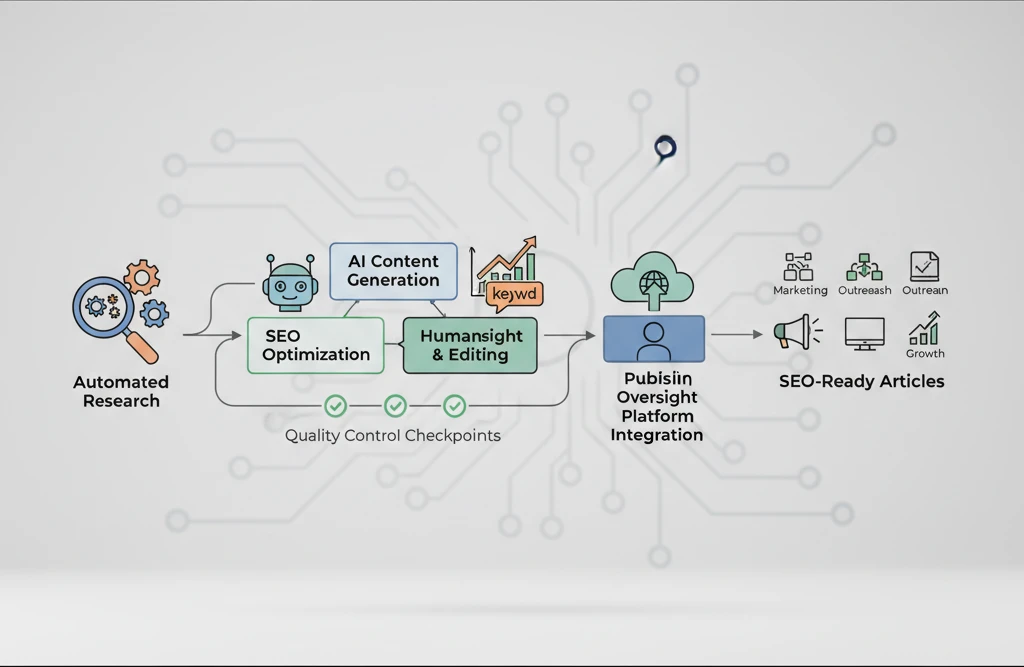
Scaling content production through automation necessitates robust management and approval processes to maintain quality and brand consistency. While automation handles the heavy lifting, human oversight remains critical. Implement a tiered review system: first, an AI quality check for grammatical errors and basic SEO compliance, followed by a human editorial review for nuance, brand voice, and factual accuracy. Establish clear guidelines and checklists for your editorial team to ensure every piece meets predefined standards before publication. For example, a content manager might have a checklist that includes verifying statistics, ensuring brand tone adherence, and checking for any unintentional repetition. Utilizing tools that allow for collaborative editing and feedback loops directly within the platform is highly beneficial. Furthermore, develop a process for handling feedback on automated content; this feedback should be used to refine the AI prompts and parameters for future content generation, creating a continuous improvement cycle. This ensures that while content is produced at scale, quality control remains paramount. Regularly audit a sample of published content to identify any systemic issues and adjust your workflow accordingly.
Maintaining Content Freshness with Topic Rotation
In the dynamic landscape of SEO, content staleness is a silent killer of organic visibility. Search engines favor content that is relevant, up-to-date, and addresses evolving user needs. Topic rotation, powered by intelligent automation, is the antidote to this problem. Instead of relying on a static content calendar, an automated system can continuously identify and surface new angles, emerging trends, and seasonal opportunities. This proactive approach ensures your website remains a valuable and current resource for your audience. By intelligently diversifying your content topics, you not only capture a broader range of keywords but also demonstrate to search engines that your site is actively engaged with its domain. This dynamic content strategy is fundamental to long-term SEO health and sustained organic growth. It moves beyond simply publishing content to publishing the *right* content at the *right* time.
The goal of topic rotation is to avoid becoming predictable or repetitive in your content output. This means moving beyond a narrow focus and exploring adjacent topics, different audience segments, or varying content formats. For example, if you primarily focus on technical aspects of a product, topic rotation might involve exploring user success stories, industry applications, or beginner’s guides. This diversification can attract new segments of your target audience and create internal linking opportunities that strengthen your overall site authority. An automated system can analyze your existing content inventory and identify gaps, suggesting new areas to explore based on user behavior and market trends. This ensures that your content strategy is not just about quantity but also about strategic breadth and depth. By actively managing your content’s thematic diversity, you build a more resilient and comprehensive SEO footprint.
Strategies for intelligently diversifying your content calendar
Intelligent diversification of your content calendar relies on understanding your audience’s journey and the broader industry landscape. Start by mapping out different stages of the customer lifecycle, from awareness to consideration and decision. Your content should cater to each stage, ensuring you capture users at various points in their search. For instance, awareness-stage content might be broad trend analyses, while decision-stage content could involve feature comparisons or ROI calculators. Beyond the customer journey, explore different content formats: not every piece needs to be a long-form article. Consider infographics, video scripts, podcast outlines, or interactive tools. AI tools can analyze your current content mix and suggest formats that are underrepresented but align with high-potential topics. Furthermore, dedicate segments of your calendar to evergreen content that remains relevant over time, and other segments to timely, trend-driven pieces. This balanced approach ensures both consistent foundational authority and topical relevance. For example, a financial services firm might schedule monthly deep dives into long-term investment strategies alongside weekly analyses of current market fluctuations. This strategic mix keeps the audience engaged across different needs and time horizons.
Using AI to identify trending topics and seasonal content opportunities
AI is an indispensable tool for uncovering timely content opportunities that might otherwise be missed. By monitoring search trends, social media conversations, and news cycles, AI algorithms can identify emerging topics and shifts in user interest before they become saturated. This allows you to be an early mover, capturing valuable organic traffic. For instance, if a new technology emerges in your industry, AI can flag it as a significant trend, prompting you to create foundational content around it. Similarly, AI can identify seasonal peaks in search interest, such as holiday-related queries or annual event discussions. This enables you to plan and publish content proactively, aligning with audience demand. A powerful AI platform can analyze search volume fluctuations, competitor content saturation, and user engagement signals to recommend topics with the highest potential ROI. For example, an AI might alert you that searches for “sustainable fashion trends for autumn” are increasing, suggesting a timely blog post. This data-driven approach to content ideation ensures your efforts are focused on what users are actively searching for right now. It provides actionable insights, moving beyond guesswork to informed content creation.
Avoiding content staleness: a proactive approach to SEO health
Content staleness occurs when your website’s information becomes outdated, inaccurate, or no longer relevant to current search intent. This negatively impacts your search rankings and user experience. A proactive approach involves regularly auditing your existing content and updating it, but automation takes this a step further by preventing staleness from occurring in the first place. By employing intelligent topic rotation, you are continuously introducing fresh perspectives and up-to-date information. The AI can be programmed to flag content that is approaching a certain age or is related to a rapidly evolving subject matter, triggering a review or suggesting an update. For example, if you have a guide on “Best Digital Marketing Tools,” and new tools have emerged or existing ones have significantly updated features, the AI can recommend refreshing this content. Beyond updates, rotation ensures that your content strategy itself doesn’t become stale. Regularly introducing new themes, formats, and even competitor comparisons (as discussed later) keeps your site dynamic. This continuous refresh cycle signals to search engines that your site is a living, evolving resource, which is a strong ranking factor. Implementing an AI-driven system for identifying and addressing content decay proactively safeguards your SEO investments.
Competitive Analysis in an Automated Content Era
In today’s competitive digital landscape, understanding your rivals’ strategies is not just beneficial; it’s essential for survival and growth. Automated competitive analysis provides a scalable and efficient way to gain these crucial insights. Instead of manual deep dives that are time-consuming and prone to human bias, automation tools can continuously monitor competitor websites, content output, keyword rankings, and backlink profiles. This allows you to stay informed about their moves in real-time, identifying their strengths, weaknesses, and emerging opportunities. The insights gained from this continuous monitoring are invaluable for refining your own SEO and content strategies. By understanding what your competitors are doing successfully, you can adapt and improve your own approach, ensuring you remain competitive. This ongoing strategic intelligence is a powerful lever for outmaneuvering rivals and capturing market share. It transforms competitive research from a periodic task into a dynamic, integrated part of your growth engine.
The automation of competitor analysis extends to identifying not just their published content but also the themes and topics that resonate most effectively with their audience and search engines. AI-powered tools can analyze large volumes of competitor articles to discern recurring themes, popular keyword clusters, and the types of content that consistently achieve high rankings or engagement. This granular understanding goes beyond surface-level observation. For example, an AI could identify that a competitor is seeing significant success with content focusing on “AI-powered customer service solutions for e-commerce,” even if they haven’t explicitly stated this as a strategy. By uncovering these emerging content themes, you can identify underserved niches or opportunities to create superior content that captures this demand. This process enables you to pivot your strategy based on concrete data, ensuring your content efforts are always aligned with market demand and competitive activity.
Automating the monitoring of competitor content strategies
Automating the monitoring of competitor content strategies involves setting up systems that continuously track key metrics across rival websites. This includes monitoring their publishing frequency, the types of content they produce (blog posts, whitepapers, videos), their primary topic clusters, and their promotional efforts on social media. AI-driven platforms can crawl competitor sites, analyze their new publications, and compare them against your own content calendar. This can be configured to trigger alerts when a competitor launches a significant new content series or starts heavily focusing on a particular keyword. For example, you might set up an alert to notify you if a top competitor publishes more than three articles within a week on the topic of “SaaS customer onboarding.” This real-time competitive awareness is crucial for making timely strategic adjustments. Furthermore, these tools can track changes in competitor keyword rankings, identifying which of their content pieces are gaining traction and why. This data provides actionable insights into what resonates with your shared target audience and allows you to adapt your own strategy accordingly to capture market share.
Identifying emerging competitor content themes and performance metrics
Beyond simply tracking what competitors publish, advanced automation can identify underlying content themes and their performance. AI algorithms can analyze hundreds or thousands of competitor articles, using natural language processing to group them by topic and sub-topic. This reveals not just what they are writing about, but the overarching narratives and strategic directions they are pursuing. For instance, an AI might identify that several competitors are all converging on the theme of “ethical AI implementation in marketing,” even if their individual articles are diverse. Coupled with performance metrics—such as estimated traffic, backlink acquisition, and social shares—this reveals which themes are driving the most organic success for them. This insight is invaluable for uncovering content gaps in your own strategy. For example, if competitors are gaining significant traction with content around “AI for personalized customer journeys,” and you haven’t explored this deeply, it signals a clear opportunity. By identifying these emerging themes and their associated performance, you can preemptively develop content that addresses market demand and challenges competitor dominance. This data-informed approach is critical for staying ahead in the competitive content game.
Using AI insights to inform your own competitive content positioning
The ultimate goal of automated competitive analysis is to translate raw data into actionable strategic positioning. AI insights should directly inform your content creation and promotion efforts. If your analysis reveals that a competitor is dominating a specific keyword cluster with shallow content, you can create a more comprehensive, in-depth resource to capture that traffic. Conversely, if competitors are excelling with a particular content format, such as detailed case studies, you might adapt your strategy to include more of those. The AI can also help identify where your own content is underperforming relative to competitors, suggesting areas for improvement or expansion. For example, if competitor analyses show that they consistently rank higher for “SEO content strategy for e-commerce,” and your own content on this topic is not performing well, you might use AI to identify keyword gaps or structural weaknesses in your existing articles. This data empowers you to make data-driven decisions about your content’s focus, format, and unique selling proposition. By understanding competitor positioning, you can carve out your own distinct advantage and ensure your content is not just present, but impactful and differentiated. Ultimately, this leads to a more robust and defensible SEO strategy.
Measuring the ROI of Scaled SEO Content Automation
As businesses invest in scaling their SEO content efforts through automation, a critical question arises: what is the return on this investment? Measuring the ROI of automated content involves a clear understanding of the key performance indicators (KPIs) that truly reflect success, moving beyond vanity metrics. Automation, by its nature, aims to increase efficiency and output. Therefore, ROI measurement should focus on tangible outcomes such as increased organic traffic, higher search engine rankings for target keywords, improved conversion rates from organic visitors, and ultimately, revenue growth attributed to SEO. By tracking these metrics consistently, businesses can quantify the impact of their automated content strategies and justify continued investment. This data-driven approach ensures that automation efforts are not just producing content, but are actively contributing to the bottom line. It’s about demonstrating that investing in efficiency leads to demonstrable growth.
Attributing organic traffic growth specifically to scaled content efforts can be complex, but automation provides clearer pathways for this attribution. When you automate the creation and publishing of optimized content, you can directly link increases in traffic to these efforts. Tools that track content performance over time, correlate publishing schedules with traffic spikes, and analyze keyword ranking improvements can provide this attribution. For instance, if you launch an automated campaign to publish ten new blog posts on specific long-tail keywords, and you observe a subsequent rise in organic traffic from those keywords, the connection becomes evident. This requires careful setup of analytics and tracking mechanisms. By understanding which automated content pieces are driving the most engagement and conversions, you can refine your strategy and allocate resources more effectively. This direct attribution is crucial for understanding the true value of your scaled content operations. The ability to see which automated workflows lead to the most valuable traffic is a game-changer.
Key performance indicators (KPIs) for tracking the success of automated content
To accurately gauge the success of scaled SEO content automation, focus on specific, measurable KPIs that reflect business objectives. Primary indicators should include organic traffic volume and its growth rate, tracking the total number of visitors arriving from search engines. Monitor the number of targeted keywords that reach the first page of search results and their average position changes, as this directly correlates with content visibility. Conversion rates are paramount: track how many organic visitors complete desired actions, such as filling out a form, making a purchase, or signing up for a newsletter. The cost per lead (CPL) or cost per acquisition (CPA) generated through organic channels is another vital KPI, as automation should reduce these costs. Engagement metrics like bounce rate, average session duration, and pages per session can also indicate content quality and relevance. Finally, consider the number of leads or sales directly attributable to content published via automation. By focusing on these revenue-generating and efficiency-focused metrics, you can clearly demonstrate the ROI of your automated content strategy.
Attributing organic traffic growth to scalable content efforts
Attributing organic traffic growth to scaled content efforts requires a methodical approach, especially when automation is involved. The first step is to establish a baseline of your organic traffic performance before implementing large-scale automation. Then, as you deploy automated content workflows, meticulously track the timing of these deployments against changes in your organic traffic. Tools like Google Analytics and search console reports are essential for this. You can segment your traffic data to isolate visitors arriving from new content pieces or content clusters targeted by your automation. For example, if you automate the creation of a series of articles around a specific product feature, monitor the traffic to that entire cluster of pages. Analyze keyword ranking movements for the keywords associated with these automated articles; a significant climb in rankings for a new piece of content directly supports attribution. Furthermore, leverage UTM parameters and goal tracking within your analytics platform to connect specific content to desired outcomes. This data linkage allows you to confidently state that the increase in organic traffic is a direct result of your scalable content initiatives, rather than a general market trend. This clarity is vital for strategic planning and resource allocation.
Calculating the cost savings and efficiency gains of automation
Quantifying the cost savings and efficiency gains from SEO content automation is crucial for demonstrating its value. Begin by calculating the average cost of producing a single piece of content manually. This includes expenses for writers, editors, SEO specialists, and project management time. Then, compare this to the cost of producing a similar piece of content using your automation platform, considering subscription fees, setup costs, and any necessary human oversight. The difference represents your direct cost savings per content piece. Furthermore, calculate the time saved. If manual content creation takes 10 hours per article and automation reduces this to 2 hours of oversight, you’ve saved 8 hours per article. Multiply this saved time by the hourly rate of your team members to quantify the efficiency gain in monetary terms. Consider the increased output: if you can now publish 50 articles per month instead of 20, that’s an increase of 30 articles. The revenue or lead generation potential from these *additional* pieces of content represents a significant gain. Documenting these figures—such as reduced cost per article and a 3x increase in content output—provides a clear, quantifiable picture of the benefits, justifying the investment in automation platforms like SEO45 AI.
Ethical Considerations and Best Practices for AI Content Automation
While AI content automation offers immense potential for scaling publishing efforts, navigating its ethical landscape is paramount. Businesses must prioritize transparency and responsible deployment to maintain audience trust and adhere to evolving digital standards. Overlooking these aspects can lead to significant reputational damage and hinder long-term growth.
Transparency and disclosure in AI-assisted content creation
When AI plays a significant role in content creation, clear disclosure is no longer optional but a foundational element of ethical practice. Audiences deserve to know when content has been generated or heavily assisted by artificial intelligence. This is particularly crucial for sensitive topics or in industries where expert human authorship is traditionally expected. For instance, a medical or legal advice article generated primarily by AI, without clear labeling, could mislead readers and have serious consequences. Implementing a subtle but evident disclaimer, such as “This article was written with AI assistance and reviewed by a human editor,” builds trust. Platforms can utilize this approach to ensure readers understand the origin of the information, fostering an environment of informed consumption and mitigating potential misuse. This practice aligns with the growing user demand for authenticity and honesty in digital interactions.
Combating AI-generated spam and maintaining content quality standards
The ease with which AI can generate vast amounts of content presents a challenge: the proliferation of low-quality, repetitive, or even nonsensical material that masquerils as helpful information. Search engines and users are becoming increasingly adept at identifying and penalizing such content. To combat this, a robust quality control framework is essential. This involves not only AI-driven checks for grammatical errors and plagiarism but also human editorial review to ensure factual accuracy, originality of thought, and alignment with brand voice. Implementing automated systems that flag content for potential quality issues before human review can significantly improve efficiency. For example, a system might flag articles that lack novel insights or rely too heavily on generic phrasing. Maintaining high standards also means ensuring that automated content contributes meaningfully to user search intent, rather than merely flooding the internet with redundant information. This proactive approach to quality ensures that your automated content efforts enhance, rather than detract from, your SEO performance.
The evolving role of human oversight in AI-driven content strategies
AI-powered content automation does not eliminate the need for human expertise; rather, it redefines it. The role of content professionals is shifting from manual creation to strategic oversight, editing, and refinement. Humans are indispensable for tasks requiring nuanced understanding, creativity, empathy, and critical judgment. This includes developing overarching content strategies, identifying unique angles, fact-checking complex information, and infusing content with brand personality and emotional resonance. Think of AI as a highly efficient research assistant and first-draft generator, but the final polish, strategic direction, and ethical validation come from human editors and strategists. By leveraging AI for the heavy lifting of research and initial drafting, teams can dedicate more time to advanced AI applications, competitor analysis, and user experience optimization, ensuring content not only ranks but also deeply connects with its intended audience. This synergy between human intelligence and artificial intelligence is key to building truly impactful content systems.
Building a Sustainable Organic Growth Engine with Automation
Automating content creation and publishing can be a powerful catalyst for organic growth, but its true strength lies in its integration into a comprehensive digital marketing strategy. By strategically deploying AI tools, businesses can achieve consistent content output, maintain topic diversity, and continuously refine their approach based on performance data. This builds a reliable engine that fuels search visibility and audience engagement over the long term.
Integrating automated content into a broader digital marketing strategy
Automated content should not exist in a vacuum; it must be a deliberate component of a wider marketing ecosystem. This means aligning AI-generated articles with specific business objectives, such as lead generation, brand awareness, or customer education. For instance, automated content can be designed to act as lead magnets, driving traffic to landing pages where visitors can download valuable resources. Furthermore, the output from content automation tools needs to be distributed across relevant channels—social media, email newsletters, and paid promotion—to maximize reach. Regularly analyzing the performance of automated content, using metrics beyond simple traffic, such as conversion rates and time on page, is crucial for understanding its contribution to overall marketing goals. This holistic approach ensures that automated publishing serves a clear purpose and actively contributes to sustainable organic traffic growth, rather than just increasing content volume.
Long-term planning for content evolution and AI advancements
The landscape of SEO and AI is constantly shifting. A sustainable content automation strategy requires foresight, anticipating how search algorithms and AI capabilities will evolve. This involves building flexibility into your content systems, allowing for easy adaptation to new trends and algorithm updates. Instead of focusing solely on immediate keyword targets, plan for thematic content clusters that address broader user needs over time. Regularly review your content strategy, perhaps through AI-powered content audits, to identify gaps and opportunities. Stay informed about emerging AI technologies and how they might enhance your content creation and optimization processes. This forward-thinking approach, focused on continuous improvement and adaptation, ensures that your content remains relevant and effective, solidifying your position as a leader in your niche.
Empowering your team to focus on strategy and high-value tasks
The primary benefit of automating repetitive content tasks is freeing up your team’s valuable time and cognitive resources. Instead of spending hours on mundane research, outlining, or initial drafting, your marketing and content professionals can pivot to higher-impact activities. This includes developing innovative content campaigns, conducting in-depth competitor analysis to uncover strategic content gaps, refining user personas, and building stronger audience relationships. Automation allows strategists to focus on the “why” and “how” of content, ensuring it aligns with business objectives and resonates deeply with the target audience. This shift empowers individuals to engage in more creative problem-solving and strategic planning, ultimately leading to more effective marketing outcomes and greater job satisfaction. It transforms the team’s role from pure executors to strategic architects of the brand’s online presence.
By adopting a thoughtful approach to AI content automation, businesses can not only scale their publishing efforts but also build a resilient foundation for sustained organic growth. This involves maintaining ethical standards, ensuring high-quality output, and strategically integrating automated content into broader marketing initiatives.
For businesses looking to implement sophisticated content systems that leverage AI for research, optimization, and publishing, exploring platforms like seo45.com can provide the necessary tools and workflows to streamline operations and drive measurable results.